

I have been thinking a lot recently about that over-used expression, ‘customer centric’.
Forrester in 2005 had a deck on the customer experience value chain. They have a high level model to express the value chain:
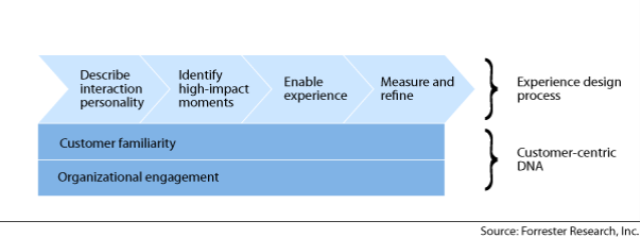
The model displays the characteristics of a customer centric organisation,
customer familiarity
- field research
- design persona
organisational engagement
- Since internal alignment remains a critical challenge to improving customer experience, firms can’t just rely on the nebulous notion of “executive buy-in.”
- To create the change necessary across the company, firms need to engage in company wide efforts that demonstrate a clear commitment to serving customer needs.
….. alongside the experience design process …….
describe interaction personality
- address the chasm that exists between marketing messages created in corporate marketing and the interactive experiences delivered by the rest of the organization — in the retail branches, on the phone, or on the Web
identify high impact moments
- companies need to identify which ones have the largest impact on users.
- There’s no magic step in identifying these “moments of truth” — firms need to uncover what’s really important to their target customers
enable experience
- craft interactions that will resonate positively with key customers by focusing on the right things
measure & refine
- portfolio of measurement tools and approaches for tracking what customers do, what they experience, who they are, and what they think
Locating tests for determining the success of a firm at becoming customer centric is essential. Everyone says they are but is the organisation customer centric. For example no-one will ever say they are not customer centric. If you ask someone in the Deposits product group, or the mortgage group, “are you customer centric” you will get a resounding yes.
But the organisation needs to reflect on those answers … the deposit guys are customer centric to deposit customers, and the mortgage guys are customer centric to mortgage customers. Yet the deposit customers have mortgages, and vice versa.
Even if a centralised marketing group is handling the marketing, if they are designing their marketing based on product campaigns, and seasonal product timings this is not customer centric either.
Customer centric has to mean being a genie in the bottle for your customers. When you are not needed, you sit quietly in the bottle, but, on command appear to grant wishes.
Product marketing worked in traditional media, when customers had no other offers. But today, customers have been direct mail spammed, email spammed, banner ad spammed, and TV ad spammed to death.
We have to consider the media savvy consumer of the 21st century armed with spam killing devices such as, e.g..
- firefox ad blocker
- popup blockers
- tivo for skipping television ads
- gmail with advanced spam blocking
- wordpress blog hosting with blog spam comment blocking
- online bill presentment (so no mail spam with the bill)
This is a very different consumer. They will buy when they are ready. It requires re-engineering of the marketing process to get sales with this customer. Customer centric has to be about understanding them implicitly, real time, on their schedule.
Relevance to Bankwatch:
Understanding how to maneuvre the organisation to become customer centric is essential for survival long term, because consumers are evolving as generations appear.
tags: customer+centric
 Bankwatch
It’s something banks (and all other companies) say once in a while to remind themselves that there are, in fact, customers out there. Giant companies have a way of becoming their own beast that needs to be fed, and employees begin to think their job consists solely of feeding it. “Work” becomes an end in itself, rather than just a means to an end (i.e., serving the customer).
I don’t think there’s any deeper meaning than that. It’s a market correction to the phases a company goes through when things become overly political (say, after a huge re-org) or internally focused (say, when company targets have been risk mitigation or cost management). It’s a noble endeavour, to be sure, but the idea of serving the customer is at constant odds with serving the ego and processes of the company.
So that’s the ‘why’ we have what we have. But surely there’s a way to organise to at least have a chance of killing the beast.
Sure. Ensure your employees have no sense of politics or ambition. 🙂