

Interesting paper from IBM Global Services, designed to solve a problem many big banks suffer from. They have overly complex systems, that are inflexible, and seemingly impossible to get operating efficiently and effectively.
One symptom is well captured here, and I personally recognize this one.
Many transformation failures where projected benefits were not realized or costs spiraled are due to large scale multi-year programs which are difficult to manage. In such programs it is often difficult to maintain focus on vision, costs, benefits and end solution. Additionally, the end solution may not be relevant should the business environment change.
In place of such large scale projects, the paper proposes a progressive model.
Progressive transformation differs from such large scale change programs by breaking down the transformation journey into incremental steps that provide the flexibility to change direction should the business or technology environment change.
Banks today suffer from a design problem.
For many banks, products, channels and lines of business are only partially integrated, and organizations continue to be structured along product or geographic lines rather than customer segments.
Once customer segments are chosen as the building block, then the Bank is on the journey towards customer centricity, and Banking can be seen as relatively simple, and can be broken down into high level layers.
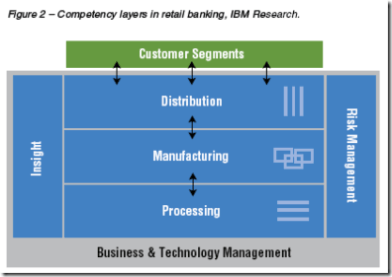
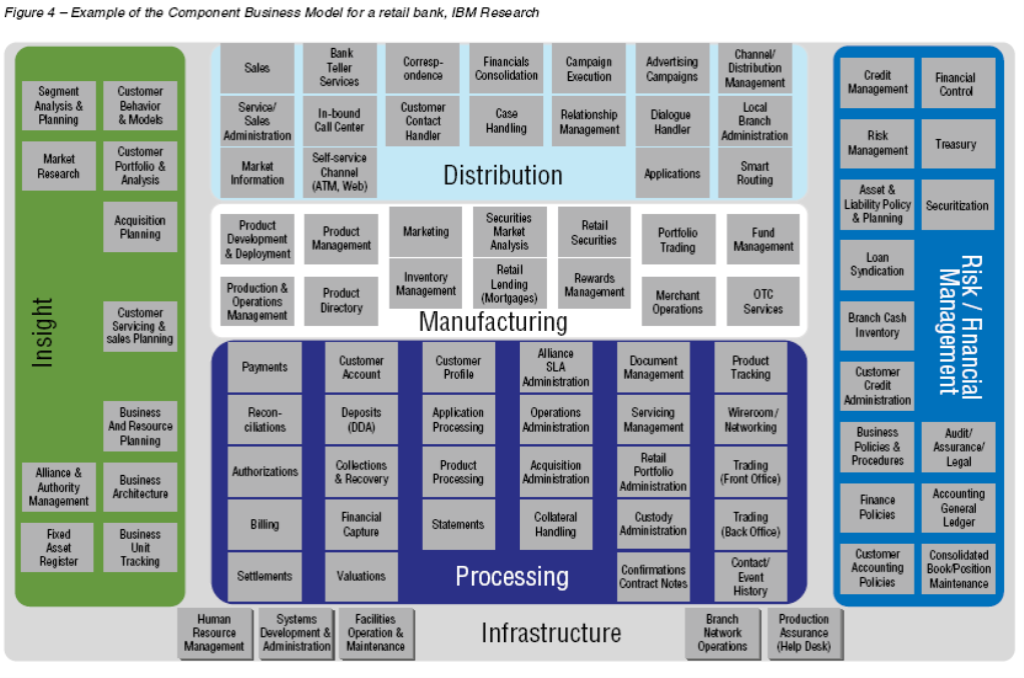
Once this approach is taken the next step is to identify the business components. Again, Banks need not be complicated, and operate only a few components, 60 – 90 on average.
Componentizing is a concept that other industries, particularly manufacturing, have adopted to deal with complexity.
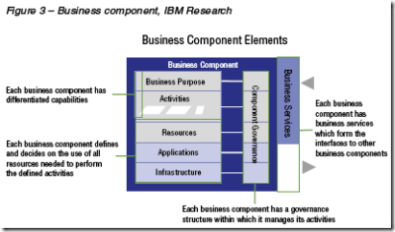
A component is a group of cohesive business activities supported by appropriate information systems, processes, organizational structure and performance measures. Using common messaging standards, information systems and service agreements, each component serves a unique
purpose and is tied to other enterprise components
(Figure 3).On average, there are 60-90 components
in a typical banking business model.
Each business component, comprises similar layers.
They provide an example of a European Banks business components laid out with this model.
Finally, they show the service maturity model derived from building the CBM (component business model) on SOA (Service Oriented Architecture).
Finally, seven steps that Banks must take.
• Create a vision for growth, flexibility and the capability of leveraging the entire enterprise
• Build a governance structure and begin the cultural change for this transformation
• Transform in a progressive manner based on business value
• Ensure that duplication and complexity are
intercepted right at the business level. CBM asks
key questions about common business components
across products, processes and business units• Build an IT foundation that will link to CBM based on SOA
Relevance to Bankwatch:
If only it were that simple!
tags: systems+architecture, IBM, CBM, component+business+model, SOA, service+oriented+architecture
 Bankwatch
One thought on “Simplifying the business model”
Comments are closed.