

I heard of a North American Bank using this method to assess customer loyalty. I was skimming some GE analyst reports and surprise, they are using it too, and I’ll bet invented it.
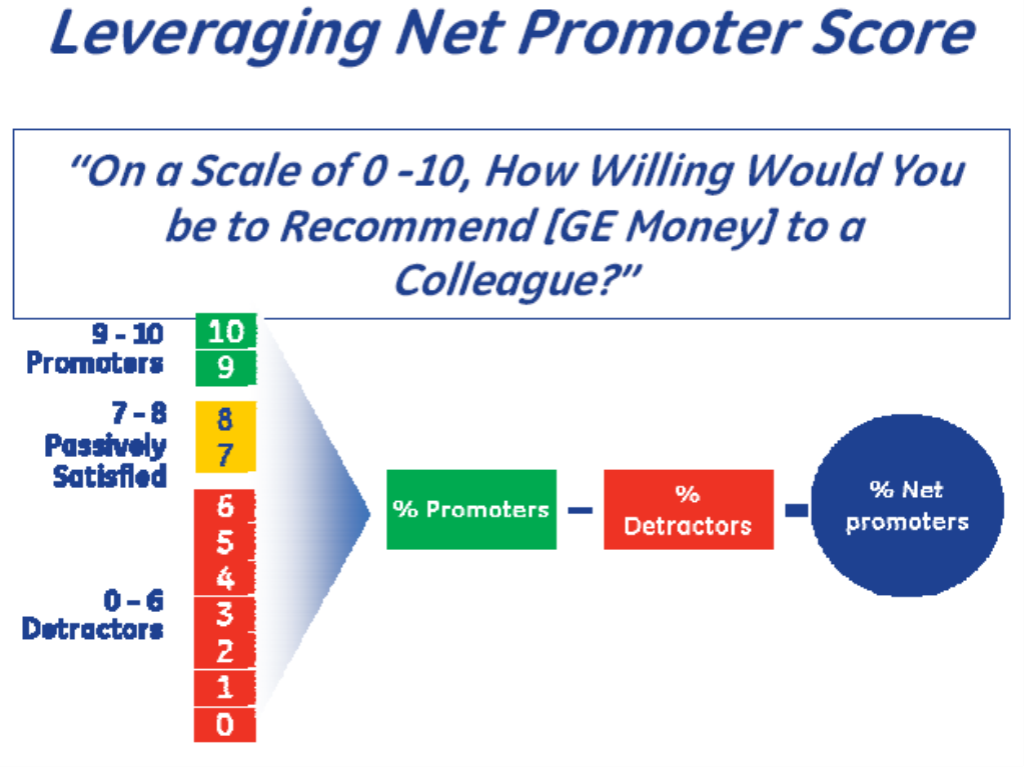
The concept as I understand it is intended to be:
- simple
- easy to understand
- give equal weight to both top box scores, and bottom scores
Typical customer loyalty is a horrendous amalgam of:
- satisfaction
- will use again
- willing to recommend
NPS takes the third element as being the one that trumps the others. You wont get recommendations unless you have the other elements, so its a dependency. Why not give it primacy.
Technorati tags: custom+loyalty
 Bankwatch
Could you repost the graphic? Doesn’t seem to show up.
This concept is originally from Frederick Reichheld, author of The Ultimate Question. His has written the The Loyalty Effect and Loyalty Rules. His book goes into how to make this concept work.
Thanks for that Lisa!
Thanks, Lisa, indeed. If anyone would like more information on Fred Reichheld, his latest book, or Net Promoter, you can visit the website:
http://www.netpromoter.com
Regards,
Amy Madsen
Project Manager, Netpromoter.com
As this blog pertains to the banking industry, I should have noted above that at the upcoming Net Promoter Conference, we have George A. Hofheimer, Chief Research Officer for the Filene Research Institute, speaking. Filene Research Institute is “The think and do tank” for the credit union industry.
http://www.netpromoter.com/np_conference/speakers.php#hofheimer
A number of major research firms are now incorporating this type of loyalty question into their customer satisfaction tracking. Synovate & Gallup are two that come to mind.
McKinsey Quarterly has quite a lot of good material on loyalty segmentation in this sector, and several models of loyalty-based segmentation that are quite interesting, all based on this type of approach. You do need the premium subscription to access most of that material.