

I love these cross diagrams which are used as a means to promote strategic thought in scenario planning. We used them at LIFT at Bill Cockayne‘s workshop on designing future cities. The trick is to get the right items at each end of the line – not just opposites (High/ low, cold/ hot etc), but opposing concepts that generate debate and new thought.
So I was ecstatic to see this one from Christopher over at the Social Customer Manifesto.
So, the two big questions:
- Q1: Who controls the interactions between vendor and customer?
- Q2: Are the interactions focused on transactions or relationships?
Source: The Social Customer Manifesto: VRM Scenarios
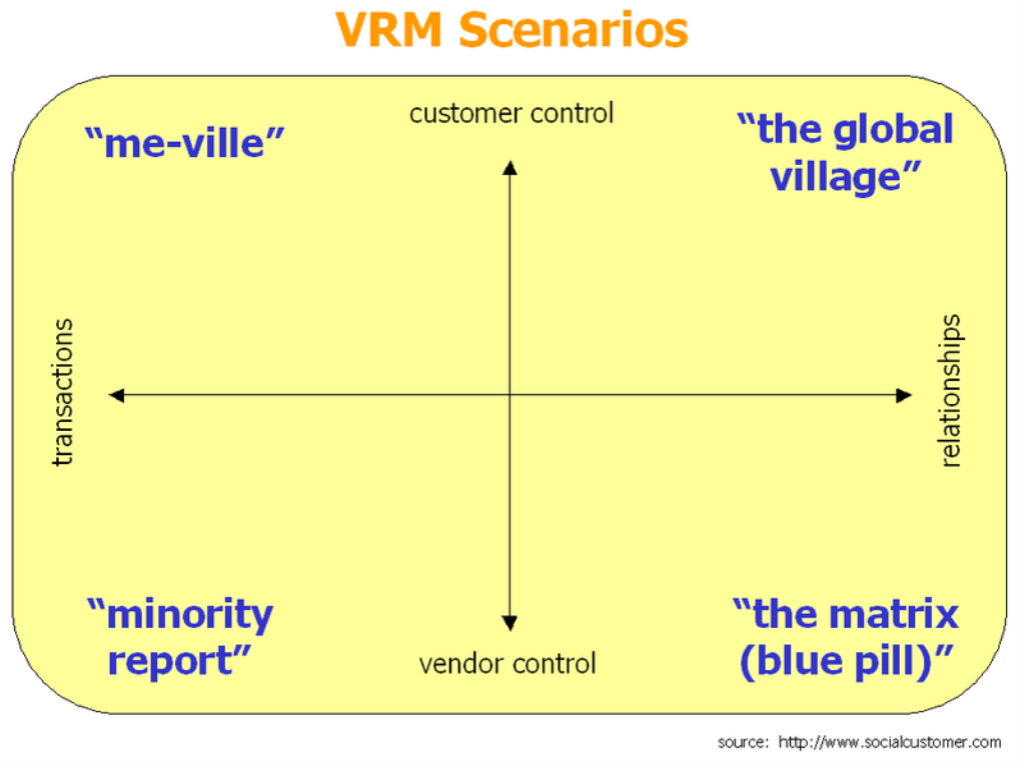
This is relevant to Banks. Online Banking is way over on the transaction side, and Banks (online) are really no-where on the relationship side. Similarly on the vertical, (Vendor means Banks here), control is on the Bank side.
So that places Banks in the lower left quadrant. Remember Minority Report? Tom Cruise walks into the Gap, and is instantly recognised, and an ad is spoken to him based on his Gap profile. the Gap decided on that ad .. Cruise had no control over it – this is ‘facist’ marketing with all control divested to the corporations. Marketing that is intended to shape you and tell you what to think.
Anyhow, Christopher does a fantastic job of describing the four quadrants, that I can’t improve on.
Where is the optimal quadrant? To me the answer is clear – upper right! Reason: Here is Christopher description:
The customer owns her own information, and does with it what she pleases. In some cases, anonymous transactions are conducted, but most interactions happen with trusted vendors with whom the customer has dealt over time. The customer chooses vendors based on interpersonal empathy and affinity, as well as technical capability
To me this is the only vision that works. The problem is that customers do not own their own information. The opportunity for Banks is to fill that void by giving control of information to customers as if they did own it. This would be responsible, and would gain enormous customer credibility.
 Bankwatch
colin…thanks for the good words! best, c
You deserved them Christopher … that was one insightful post.