

Let me state at the outset, I am an ardent believer in Social Networks as a concept.
However I have real issues with the value in Linkedin, MySpace and Facebook, just to name three. I have found something that’s new to me (perhaps not to others) that helps define the characteristic of my doubts, but more importantly the outline of the solution.
Dunbar supports this hypothesis through studies by a number of field anthropologists. These studies measure the group size of a variety of different primates; Dunbar then correlate those group sizes to the brain sizes of the primates to produce a mathematical formula for how the two correspond. Using his formula, which is based on 36 primates, he predicts that 147.8 is the “mean group size” for humans, which matches census data on various village and tribe sizes in many cultures.
Source: Life With Alacrity: The Dunbar Number as a Limit to Group Sizes
In layman’s terms, the Dunbar theory says that humans can have some degree of useful interaction up to 150 people.
In this excellent piece of analysis, Christopher Allen, goes further and relates the original analysis to modern applications such as teams, and corporate environments.
The original Dunbar thing was related to tribal, physical environments:
… there is a cognitive limit to the number of individuals with whom any one person can maintain stable relationships,
There are key assumptions within Dunbar’s theory apparently:
Dunbar’s work itself suggests that a community size of 150 will not be a mean for a community unless it is highly incentivized to remain together.
The incentive within the Dunbar world were things like survival, communication, all of which resulted in villages environments. I won’t restate Christopher’s analysis or I will just confuse it …. he covers this very well.
Christopher adds that the upper end of working groups today is 150. This is based on his experience in facilitation, and observation of groups.
My anecdotal evidence generally seems to support the idea that group sizes will usually plateau at a number lower than 150 participants.
He then relates to a set of groups, that are both online, and highly incented to remain together… gamers.
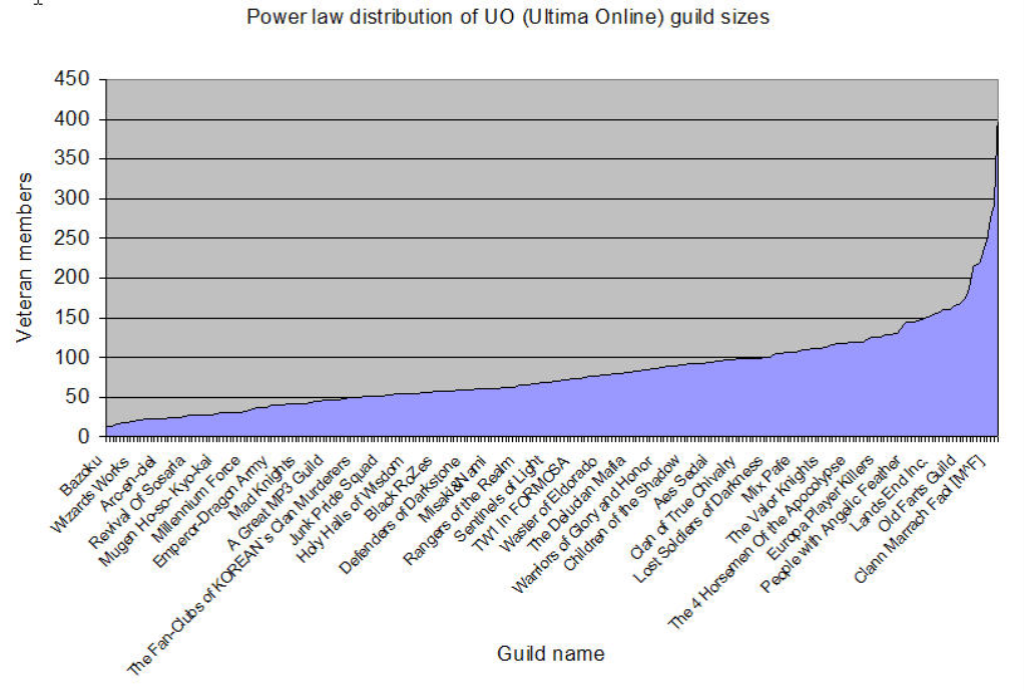
There is a definite leaning towards groups of 150 or less.
As one of the group organisers confirmed:
The numbers match up with my (currently) mostly anecdotal evidence for Asheron’s Call. We have allegiances in the hundreds and even thousands of members, but most of those members are inactive, non-participatory in the group on a regular basis or are mule accounts for farming XP. It is rare to have more than 40 or so active participants in an Allegiance.
Then he refers to Danah Boyd’s recent post, where she says:
Just as monkeys groomed to maintain their networks, humans gossiped to maintain theirs! He found that the MAXIMUM number of people that a person could keep up with socially at any given time, gossip maintenance, was 150.
This doesn’t mean that people don’t have 150 people in their social network, but that they only keep tabs on 150 people max at any given point.
This bears out the ineffectiveness of the three networks I mentioned at the outset. While it is initially satisfying to have those connections (to different degrees with each), the actual outcomes are very low in my experience, and in speaking with others. In other words, aside from the interaction there is no inherent value.
I would suggest that while people will enjoy large group interactions, such as MySpace, they are unlikely to pay for it as it stands.
The key remains how to involve social activity within a viable business model. See a VC perspective on that.
Conclusions:
Whether the right number for any person is 5 or 150, the key is how that number is embedded in a useful, qualitative way that encourages users to further participate, sufficiently that someone will pay, either the participant, or external parties who see adequate value in the participants, that the participants reciprocate. Advertising today, does not meet this requirement. Advertising online is one way, and their is no reciprocity form the participants.
 Bankwatch
The structure of social networks is generally a pyramid, where a very small percentage publish (blog), 10X more comment/engage, and most just read. Don’t quote me on the specifics, but that’s the general model. So, can we say that the Dunbar Number applies to social networks? I think it’s a bit of a different animal,but I agree with you that there is certainly a practical limit.
That limit is being tested now with Twitter, which appears to be the new “darling” of social media. I know people now who’s phones are going crazy with SMS messages because they’ve subscribed to a great number of friends on Twitter. Information overload, right? But I still think the concept of Twitter is really fascinating and can see how the data from that service can be used in aggregate in very interesting ways.
Agree re Twitter. I have experimented with it, but its hard to make it fit in … you have to fit in with Twitter.
Re pyramid … to the orchestrator of the Network it might appear as a pyramid, but I would suggest that to any one individual user, it appears as a fire hose. Thats the hypothesis that it could apply to Social Networks.