

I am increasingly fascinated by the debate on the Twitter phenomenon. Twitter in case you haven’t heard, is the latest thing in the social space. It permits users to type in any brief comment, of up to 140 characters, any time they wish. It has been referred to as micro-blogging. The encouragement is to talk about anything, and everything, what you are doing where you are going, what you are feeling, thinking, etc.
The great paradox of ‘social networking’ is that it uses narcissism as the glue for ‘community’. Being online means being alone, and being in an online community means being alone together.
Source: Rough Type: Nicholas Carr’s Blog: Dot dash
In fact a ’stream of consciousness’, whether in the form of Tweets, posts, photos or any other artifact of our day to day life isn’t really for anyone to consume. Well, not in this era anyway. It’s more of a mark of our having been here. A legacy, if you will, of our lifetime. Something for our grandchildren to look back at and see how we lived.
Source: Tara Hunt – Horsepigcow
Nicholas, and Tara nicely capture the extreme view of the arguments for Twitter, and Social Networking broadly.
My own take is that Social Networks are not necessarily well enough defined yet. The Network part is clear, but the social is not. At one extreme you have MySpace which is open, no holds barred free communication, and collaborations. Contrast that with Linkedin which is, more focussed, and provides a reasonable degrees of control over who sees your information. Also its primarily about information and reading that information, rather than communicating.
I have been considering the different styles of “Social” in Social Networks, trying to understand where each fits, and how things like Social Lending fit it. Social Lending has parts that require public provision of information, yet, other parts that could lead to very simple identity theft if information is left 100% open and unattended. So the nature of social and sharing is different for Wesabe, and Prosper, than it is for MySpace. What are those differences.
Using a method shown to us at LIFT07 and here, by Prof William Cockayne of Stanford. I came up with a first attempt at a framework, for laying out the variables to help establish the sweet spot for Social Lending.
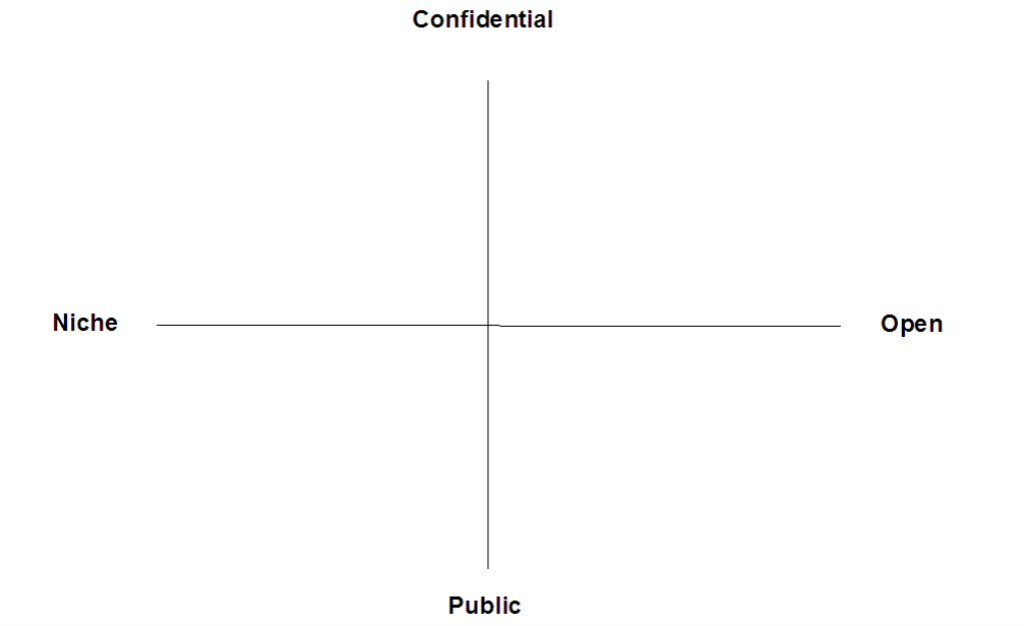
The idea here is that the axes will draw out the right thoughts. I tried a few others, but so far landed here. Any thoughts on this would be most appreciated.
Valuable (to lenders) — valuable to anyone
Willing to pay — free service (ad driven)
Social first — lending first
Confidential — public
Niche — open source
Open — Closed
Collaborative — hierarchical
Then we can add some characteristics for each quadrant. This part is best done in group, so this is my group of 1 attempt.
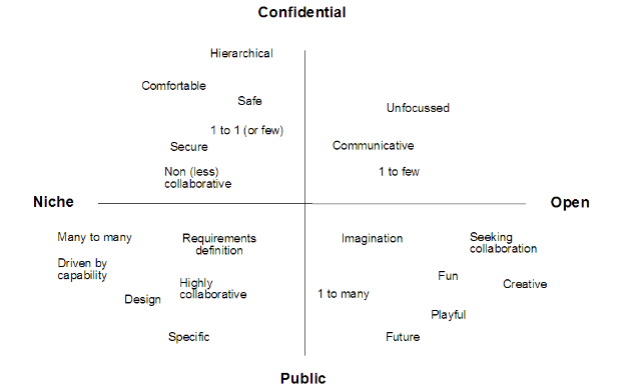
At this stage the idea is to look for hot spots, lots of points and white spots, fewer points. The latter can suggest lack of understanding, or that even the axes are wrong.
In any event and much brainstorming, that’s where I arrived. Where it got interesting is when we layer on existing, known networks and where they sit.
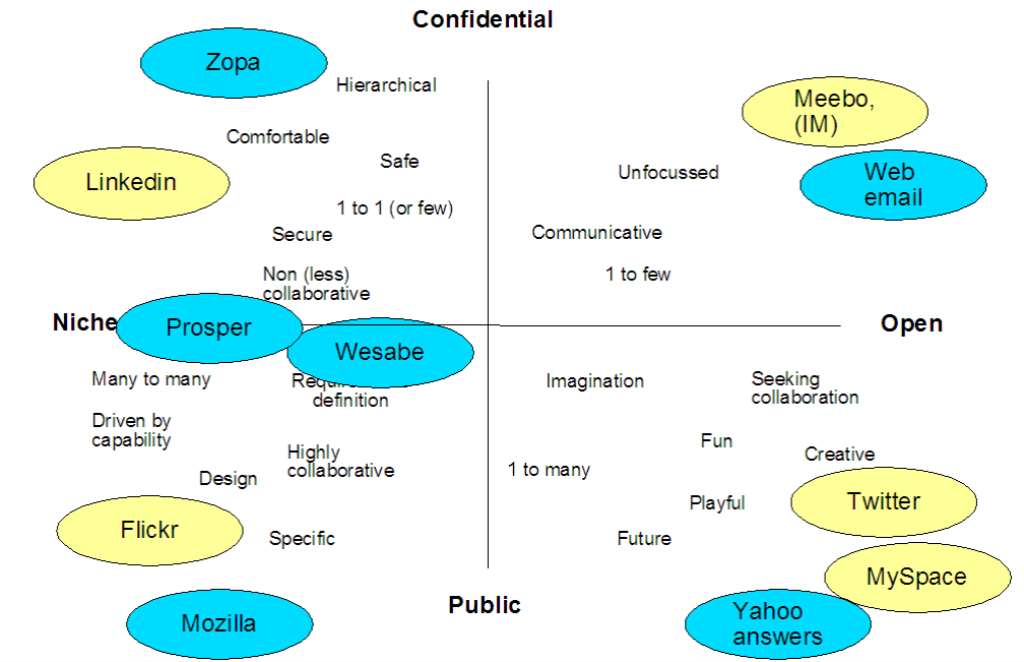
It struck me that Linkedin & Wesabe, are in the upper left, yet its not that simple. Wesabe has parts that are in the lower left too though, and this is a clue to the early future. Then try to add in Zopa, which is highly confidential, and the more social Prosper, and we start to see degrees of confidential and public, that require them to be placed differently on the ‘y’ axis.
Its easy for a MySpace to sit in the lower right, because its fun, but its also easy to see why its hard to make money there. Its harder on the left, but that’s where the value may lie. Early clue – Flickr, and Mozilla (Firefox). Both are highly successful examples. Incidentally I see Twitter in the lower right … just another tool in that space. I would suggest that Nicholas is never there, yet Tara is there all the time. This is just personal preference.
I would suggest that business modeling in a user pay scenario, generally needs to be on the left of the diagram. There has to be a point, a niche that provides a raison d’etre that will suggest I am willing to pay. A niche is more likely to promote that need in a user, and a desire to pay to receive the value. That desire to pay however, drops as we go lower on the ‘y’ (vertical) axis.
On the right hand side, users will expect the service for free, and providers, wholesalers, merchants will need to pay for it, such as through advertising.
Relevance to Bankwatch:
This may explain why its hard for Banks to engage in Social Networking. Banks is a user pay scenario, and is firmly stuck in the upper left quadrant. When anyone mentions Social everyone gravitates to MySpace, and the lower right is the antithesis of Banking.
There is early hope in the lower left however. This is where Wesabe does well ensuring the confidential parts are kept that way, yet being transparent enough about the shared parts to create common and greater value. For example the tagging of merchants and aggregation of ratings, is something that no one person can meaningfully do, yet the sum is greater than the parts.
Lots more to explore here.
 Bankwatch
This ability to “talk about anything, and everything, what you are doing where you are going, what you are feeling, thinking, etc.” reminds me of something my wife would say:
Some people have WAY too much time on their hands.
Hah! I am betting your wife is not reading the comments here, so you are safe with that one!