

Further evidence in support of the changing times we face, and that they are nothing new – epochal change happens relatively often – just at periods far enough apart that we don’t remember. The Economist picks up on a ‘radical’ from ….
A hero for the information age – Subversion, espionage and a man who gave his life to disseminate the Word | The Economist
But the country’s masters face a dilemma: the very technology, communications and knowhow that are boosting national fortunes also threaten to undermine the old power structure.
… not China today they say, but London in 1523.
The context was that of a society where the dominant book was the bible, and the idea of anything else being written down, and read by people was subversive and revolutionary. This was a time when books and pamphlets were appearing, and being destroyed.
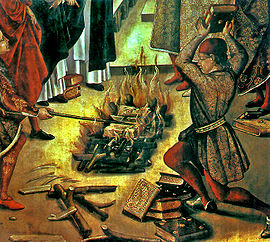
In October 1526 William Tyndale’s English translation of the New Testament was burned in London by Cuthbert Tunstal, Bishop of London. [Wikipedia]
The point of the Economist piece is that it is wrong for practices in China and other oppressive countries where Internet and new technologies are suppressed – wrong and also doomed to eventual failure. I would add in those industries that are not re-inventing itself at this time.
Book burners are all around us today – yet we are all William Tyndale.
Here are the key sections of what is a long and wonderful piece.
AN EMERGING nation looks increasingly confident as a player on the world stage, thanks to a mixture of commercial prowess and deft diplomacy. In its capital and in coastal cities, you can feel the excitement as small manufacturers, retailers and middlemen find new partners across the sea. But the country’s masters face a dilemma: the very technology, communications and knowhow that are boosting national fortunes also threaten to undermine the old power structure.
China in the 21st century, contemplating the pros and cons of the internet? No, Tudor England, at the time when a gifted, impulsive young man called William Tyndale arrived in London—not to make his fortune, but to transform the relationship between ordinary people and the written word. As he soon discovered, London in 1523 was a city where ideas as well as goods were being disseminated at a pace that frightened the authorities, triggering waves of book-burning and repression.
As a side effect of close commercial ties with northern Europe, England was being flooded with the writings of a renegade German monk called Martin Luther, who had openly defied the Pope and insisted on a new reading of the Bible which challenged some of the Catholic church’s long-established dogmas.
In some ways, Tyndale was poorly equipped to survive, let alone thrive, in this feverish atmosphere. He was no wheeler-dealer; more of an idealistic scholar whose linguistic gifts were so remarkable, and hence so subversive, that he was drawn into high religious politics.
 Bankwatch