

This is an interesting parallel to the Rogers network failure.
Both companies use Ericsson equipment and both failed same day. But I have no other information so not going there.
Today I am comparing reaction of the companies and their communication methods. The cultural differences are interesting. I also included some notes on the extent of each failure.
KDDI have been indicating serious apologies through the month with a scheduled public event Jul 29th. They confirmed the customer refund of 200 yen ($2) Jul 29th.
Rogers indication actions being taken and published through media and email. The apologies came through media releases. The refund indicated of 5 days service value was a media release later in the month.
So the differences:
- KDDI focussed on personal apologies frequently throughout the month.
- Rogers focussed on media coverage, actions being taken and how they were working wit Government to offer co-operation across other Canadian telecoms.
To North Americans the Japanese apology is heartfelt and personal. The Canadian apology is ‘sorry about’ that’ and focussed on preventing recurrence.
KDDI failure
TOKYO – A major service disruption at telecom company KDDI Corp. earlier this month affected at least 30.91 million people, becoming one of the worst such incidents in Japan, according to an accident report submitted to the communications ministry Thursday.
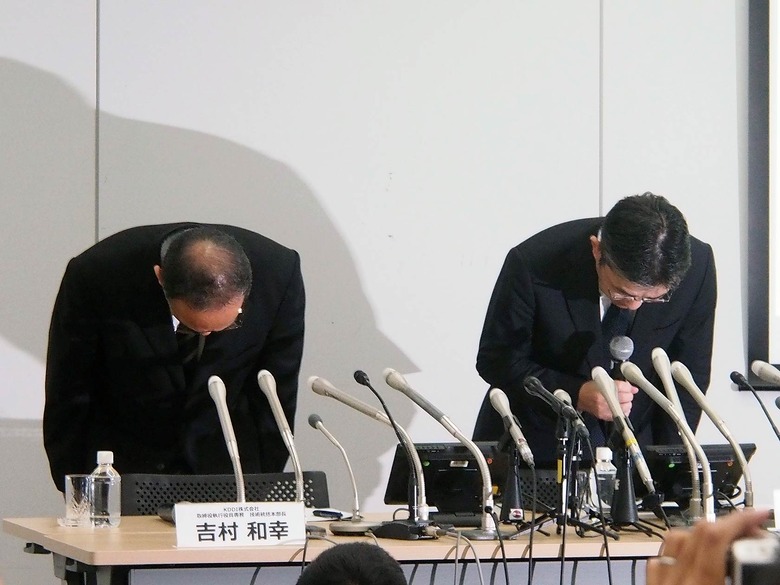
KDDI President Makoto Takahashi is slated to hold a press conference on Friday afternoon in Tokyo regarding compensation to affected users, as well as measures to prevent a similar incident from occurring again.
The plan comes as phone users were unable to dial emergency numbers such as 110 or 119 for an extended period of time during the outage, which began July 2.
The provider of the “au” mobile service — and Japan’s second-largest mobile carrier by subscribers — said the numbers of mobile connections and people affected by the disruption are the same.
KDDI said the failure occurred during maintenance of the router for voice calls, with a configuration error triggering a concentration of traffic that led KDDI to reduce user access.
Around 23.16 million phone users and more than 7.75 million users of mobile data were affected.
The outage that lasted through July 4 also disrupted banking systems, the transmission of weather data, parcel deliveries and network-connected cars, alongside the carrier’s low-cost “UQ Mobile,” lower-priced “povo,” and budget smartphone services.
KDDI at the time said it had affected up to 39.15 million mobile connections, or around 60 percent of its contracts, but amended the number after comparing normal usage volume with that during the outage.
According to the accident report, the disruption began at 1:35 a.m. on July 2 until 3 p.m. on July 4 for a total 61 hours and 25 minutes.
Approximately 86 hours had passed by the time KDDI confirmed that the network was fully restored at 3:36 p.m. on July 5.
Rogers failure
The interruption was Rogers’ second in 15 months. It began around 4:30 a.m. ET (0830 GMT) and knocked out a quarter of Canada’s observable internet connectivity, said the NetBlocks monitoring group. Outage lasted 36 hrs for most customers.
A major outage of Rogers Communications mobile and internet networks caused widespread disruptions across Canada on Friday, affecting banks, police emergency lines and customers in the second outage to hit one of the country’s biggest telecom providers in 15 months.
Customers gathered at coffee shops and public libraries to access alternate networks, while financial institutions reported problems with everything from automated machines to cashless payment systems.
“We are currently experiencing an outage across our wireline and wireless networks and our technical teams are working hard to restore services as quickly as possible,” Rogers said in a statement.
Downdetector, which tracks outages by collating status reports from a number of sources, showed reports of outages starting from 4.30 am ET, topping off at more than 20,000 users by 7 am ET. The reports dropped to around 8,000 by 11.30 am ET.
The nationwide outage resulted in some callers facing difficulty reaching emergency services via 911 calls, police across Canada said, including Ottawa and Toronto, its largest city.
Interac, which operates an email money transfer service used by several Canadian banks, said the outage was affecting its services. Toronto-Dominion Bank said it was facing system issues with Interac e-Transfer service.
Bank Of Montreal said the outage was affecting financial institutions, toll-free numbers as well as transactions, while Royal Bank of Canada said its ATM and online banking services were affected.
It was the second major outage for Rogers in a little more than a year. In April last year, thousands of its customers reported intermittent interruptions to wireless voice and data services for several hours before the company was able to restore full operations to its network.
In Ottawa’s downtown core on Friday, cafes including Tim Hortons were not accepting debit and credit cards, and turning away customers who did not have cash. Tim Hortons did not immediately respond to a request for comment on the impact on its business.
Toronto residents crowded into and around a midtown Starbucks coffee shop offering free wifi on a network unaffected by the outage.
“There’s tons of people here with their laptops just working away ferociously, the same as they would at home, because they’ve got no service at home,” said customer Ken Rosenstein
Industry Minister François-Philippe Champagne is to meet with Rogers CEO Tony Staffieri and other telecom company leaders on Monday “to discuss how important it is to improve the reliability of the networks across Canada,” according to a statement from Champagne’s office.
“We now believe we’ve narrowed the cause to a network system failure following a maintenance update in our core network, which caused some of our routers to malfunction early Friday morning,” Rogers’ Chief Executive Officer Tony Staffieri said in a statement. (Jul 9th)
 Bankwatch