

Introduction
This is a followup analysis on components that contribute the most significant changes over last few years.
I started with China and the introduction of Wolf Warrior diplomacy, the Warrior evolution and the 2023 shift which shows China providing itself greater strategic flexibility through shifts in the power of words.
Examples
It is hard to know which came first so I have attempted to capture those activities that occurred and the changes in posture that accompany them.
While Britain, Canada and Australia participated the points that follow are largely between China and US.
The China comments and the shifts in posture are not unusual for communist governments; sounding extreme and clear. Yet the words matter and the meanings from reading between the lines are essential and some deliberate shifts become apparent.
Wolf Warrior origins
By Bloomberg News
3 December 2020 at 23:41 GMT-5
It began with a tweet from Chinese foreign ministry spokesman Zhao Lijian, one of Beijing’s more prominent wolf warrior diplomats. In his post, Zhao commented on allegations that Australian soldiers serving in Afghanistan were involved in a number of unlawful killings. He included a picture depicting an Australian soldier holding a knife to the throat of an Afghan child.
The picture would have been provocative in more amicable times. But with ties between Australia and China at the worst they’ve been in decades, it was explosive.
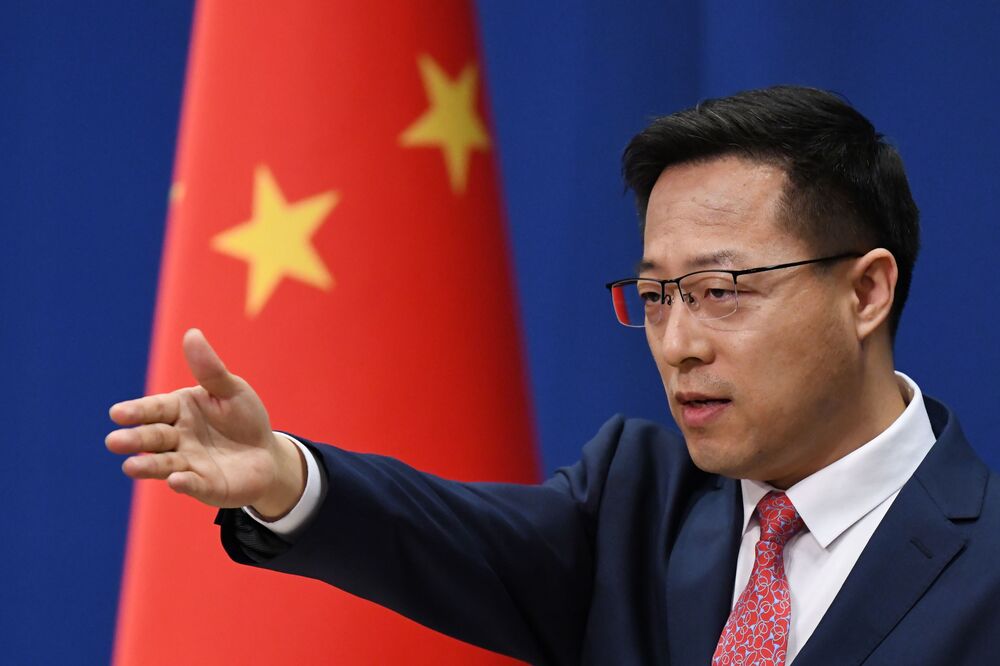
Zhao LijianPhotographer: Greg Baker/AFP/Bloomberg
Wolf Warrior Diplomacy becomes more strident
Joanna Nawrotkiewicz spoke with Peter Martin, author of China’s Civilian Army: The Making of Wolf Warrior Diplomacy (2021), to better understand the origins and impact of China’s new diplomatic tactics.
Wolf warrior diplomacy has become the shorthand expression for a new, assertive brand of Chinese diplomacy. In the past, Chinese diplomats tended to keep a lower profile and to be quite cautious and moderate in the way that they interacted with the outside world. Recently, however, they have become far more strident and assertive—exhibiting behavior that ranges from storming out of an international meeting to shouting at foreign counterparts and even insulting foreign leaders.
This turn in Chinese foreign policy has been slowly building since 2008–9 and accelerated after Xi Jinping came to office in 2012–13. After the outbreak of the Covid-19 pandemic, Chinese diplomats felt under attack but also proud of the way that their country has handled the crisis. The new mixture of confidence and increasing insecurity combined to create what we now call wolf warrior diplomacy.
Chinese diplomats believe they have been under great pressure for many years, have been constantly lectured by the United States and others about the rights and wrongs of the Communist system, and have been historically looked down upon by the Western world. They can still recall the period of “national humiliation,” either personally or from the experiences of parents and grandparents who grew up during this time and suffered tremendously at the hands of foreign powers.
The first one to gather a large audience was Zhao Lijian—spokesperson of the Ministry of Foreign Affairs and previously a diplomat posted in Pakistan. After his rise on social media, the foreign ministry realized the power these platforms could have to directly engage with both Western elite and the Western public.
You argue in your book that hostile diplomacy has been a long-standing tactic used by the People’s Republic of China from its inception. However, considering the negative reactions to these diplomatic tactics in other countries, is there any indication that the PRC will change its strategy?
Many Chinese diplomats are aware that the response to wolf warrior diplomacy has been very negative and actually damaged China’s interests in a wide range of cases. However, as during previous periods of assertive diplomacy from China, the primary audience is domestic politicians. Therefore, the reaction of foreigners and outsiders is not a top motivator for Chinese diplomats.
Wolf Warriors strongest effort
Example in Anchorage Mar 2021 – Communist Party foreign affairs chief Yang Jiechi
In his opening statements Thursday, Yang listed America’s human rights problems, referencing recent Black Lives Matters protests. “On human rights, we hope that the United States will do better on human rights,” he said. “The challenges facing the United States in human rights are deep-seated. They did not just emerge over the past four years, such as Black Lives Matter.”
The insinuation came in a series of posts on Twitter by Zhao Lijian, a ministry spokesman who has made good use of the platform, which is blocked in China, to push a newly aggressive, and hawkish, diplomatic strategy.
The big shift
The big change came in 2023 and led by Wang Li . Several demotions in the foreign ministry were followed by appearance of Wang Yi.
This highlighted a diplomatic shift bringing a coherent strategy in support of the still aggressive posture.
Wang tours EU
China’s top diplomat, Wang Yi, began his weeklong tour through Europe in Paris, meeting with French President Emmanuel Macron.
Wang travelled to Italy, Hungary, Russia, and Germany
Wang Yi visits Russsia – CNN
Wang’s high-profile visit, just days before the anniversary of the Kremlin’s full-scale invasion of Ukraine, is widely believed to be a precursor to a meeting between Putin and Chinese leader Xi Jinping. In December 2022, Putin and Xi held a virtual meeting in which the Russian leader described relations between the two nations as “the best in history,” saying they could “withstand all tests,” and invited Xi to visit Moscow in the spring of 2023 – CNN Feb 22, 2023

The new diplomatic effort was notable for missing bullet points from the Wolf days.

Gone was the words of boundless togetherness for ever, replaced by “vows to strengthen” ties.
The concerns about China providing weapons to Russia were replaced by adjustments in Natural Gas purchases, which while bad and counter to sanctions is a relatively meaningless shift: this is a safe approach.
All this to say China still sounds strong but doors are more open than before, and Xi has more room to manoeuvre during speeches and discussions.
Conclusion
I look for shifts which would alter the balance of power and impact North American investment climate and the environment in which Bank’s operate.
I can see some moderation from China; we can only speculate on the purpose. China is a Communist country and can still alter direction at a moments notice, so the Wang Yi positioning is the diplomatic approach, until it is not.
One possible purpose of Wang is that China seeks a way to soften and hinder US hegemony across Asia following the Asia pivot and without resort to military.
This approach would place the Americans as the ones required to act tactically and allow China to take the “high road” and be more strategic. It would also open doors for Xi during his next calls with US and other heads of state.
 Bankwatch