

An interesting discussion document and worth checking out because it addresses many aspects of Fintech and digitisation generally for Banks and regulators.
The eight (8) papers included.
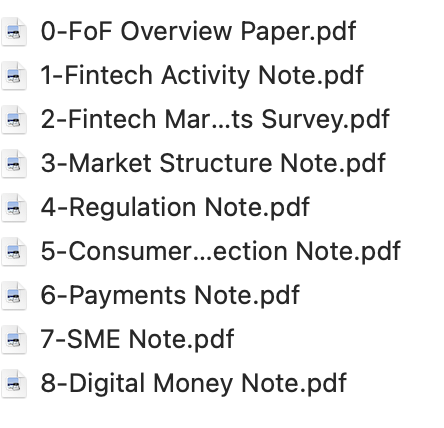
It is comprised of several papers and the introduction to the first “overview” paper including their conceptual framework.
This is worth studying and expect more to come.
Overview paper – #1 of 8.

1.1 About the Fintech and the Future of Finance Flagship Report
Digital transformation is re-shaping the market outcomes of the financial services industry. Fintech supports growth and poverty alleviation by strengthening financial development, inclusion, and efficiency and providing the financial services that are required for the digital economy to flourish. To reap these benefits, authorities will need to shape regulatory and supervisory approaches to harness these opportunities while ensuring that core policy objectives, such as stability, integrity, consumer protection, and competition, continue to be met as the digital transformation of the financial sector continues.
Digital finance has enabled providers to leapfrog legacy channels and products, particularly in EMDEs. Financial markets have seen the entry of standalone consumer fintech firms, new B2B services, and big tech firms. Incumbents have also embraced technology as a strategic priority to improve their products, lower costs, and compete. Adoption and further innovation have accelerated due to the COVID-19 pandemic, with increased digitization across many sectors, including finance, as businesses and individuals adapted to social distancing and hygiene protocols, and sought efficient and effective ways to connect remotely to government and business services (see appendix I). The pandemic thus reinforced what was already a clear trend of rapid advances in technology reshaping the economic and financial landscape globally (IMF and World Bank 2018, Pazarbasioglu et al. 2020).
This report responds to increasing demand from policy makers for guidance as their financial sectors transform.
It explores how fintech is re-shaping the structure of financial services, the implications of fintech in key product areas and for different customer segments, and potential regulatory responses. Two key questions guided these explorations:
- What are the most important likely market outcomes in terms of (i) types of financial services providers, (ii) types of business models, products, and services, (iii) market structure, and (iv) infrastructures in the financial sector in EMDEs over the next five to ten years?
- What policy responses might shape or change these outcomes in support of policy objectives and priorities, given EMDE conditions and constraints?
This Overview paper is intended as a non-exhaustive, non-technical narrative of the most salient developments and policy issues. It is aimed at senior policy makers and practitioners and draws from the set of eight technical notes (box 1) that make up the overall report. In-depth descriptions of developments, trends, and policy recommendations can be found in those notes. Appendix V contains all the executive summaries of the technical notes.
1.2 Conceptual Framework
This Overview paper is framed around the development of and interactions between four key factors that are relevant for fintech (figure 1).
| Conceptual Framework |
|---|
|
Box 1. Fintech and the Future of Finance Technical Notes Data trends and market perceptions 1. Global Patterns of Fintech Activity and Enabling Factors (Fintech Activity note) by Tatiana Didier, Erik Feyen, Ruth Llovet Montanes, and Oya Ardic 2. Fintech Market Participants Survey (Fintech Market Participants Survey) by Erik Feyen, Harish Natarajan, Guillermo Rabadan, Robert Paul Heffernan, Matthew Saal and Arpita Sarkar Policy issues 3. Fintech and the Digital Transformation of Financial Services: Implications for Market Structure and Public Policy (Market Structure note) by Erik Feyen, Jon Frost, Leonardo Gambacorta, Harish Natarajan, and Matthew Saal 4. Regulation and Supervision of Fintech: Considerations for EMDE Policymakers (Regulation note) by Tatiana Alonso Gispert, Pierre-Laurent Chatain, Karl Driessen, Danilo Palermo and Ariadne Plaitakis with contributions from Ana M. Carvajal and Matei Dohotaru 5. Consumer Protection Implications of Fintech (Consumer Protection note) by Gian Boeddu and Jennifer Chien Specific fintech products 6. Innovation in Payments: Opportunities and Challenges for EMDEs (Payments note) by Dorothee Delort and Jose Antonio Garcia Garcia Luna 7. Fintech and SME Finance: Expanding Responsible Access (SME note) by Ghada Teima, Ivor Istuk, Luis Maldonado, Miguel Soriano, and John Wilson 8. What Does Digital Money Mean for EMDEs? (Digital Money note) by Erik Feyen, Jon Frost, Harish Natarajan, and Tara Rice |
The conceptual framework
captures the implications of fintech and the digital transformation underway in financial services for market outcomes on one side, and policy making on the other, and how these two sides interact. The impact of fintech drivers on market outcomes typically requires a policy response to ensure alignment with policy objectives, which in turn shapes market outcomes, producing a feedback loop.
Fundamental technology developments shape market outcomes. Advances in computation and connectivity have produced massive amounts of data and alleviated transaction costs and frictions associated with financial services provision. These technological factors, combined with scale and scope economies and network effects, have profoundly transformed financial sector business models, products, infrastructures, market players, and market structure. These technological innovations are ultimately not purely exogenous, as innovators respond to market conditions and create the next generation of technologies.
Core policy objectives such as financial inclusion, efficiency, and stability drive the formulation of regulatory and supervisory frameworks. We distinguish longstanding policy objectives, but these too are not immutable. For example, financial inclusion and consumer data protection have emerged relatively recently as policy objectives in their own right. The objective of policy makers with respect to financial innovation is to capture the main benefits of fintech while mitigating associated risks. This requires balancing continuously evolving tradeoffs as the sector’s digital transformation progresses and market outcomes change.
These dynamics also depend on the stage of fintech development in a country. At lower levels of fintech development, the range of services, scale, and penetration is still limited. This stage requires policy makers’ willingness to support innovation and to provide basic legal and regulatory clarity. Addressing data gaps that prevent effective monitoring of risks, safeguarding the most vulnerable customers, and ensuring financial integrity objectives are met are key priorities as risks to financial stability, fair competition, and overall consumer and investor protection are still relatively low. However, as scale, complexity, and interconnectedness and possible concentration increase, more focus is necessary on safeguarding financial stability, data protection, and fair competition. This requires that legal, regulatory, and supervisory frameworks as well as technology and financial infrastructures be reviewed and strengthened to support development of a flourishing fintech ecosystem that remains consistent with policy objectives
 Bankwatch