

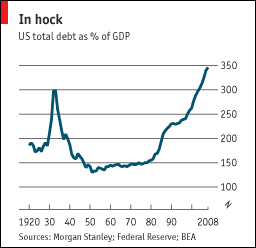
A particularly telling graph of US consumer debt / GDP. The rise from 1995 is almost exponential! ‘
A cut in overall lending would be a complete reversal of trend. Morgan Stanley reckons that total American debt (ie, the gross debt of households, companies and the government) has risen inexorably since 1980 to more than 300% of GDP (see chart), higher than it was in the Depression. Consumers, in particular, were encouraged to borrow by low unemployment and interest rates and (until last year) rising asset prices. Their debt jumped from 71% of GDP in 2000 to 100% in 2007, a bigger increase in seven years than had occurred in the previous 20.
Question de jour, given North America is in election time; is this the Governments’ fault? Who is responsible for the outcome of this new debt load?
PS … no prizes for answers, but I’d love to see the debate in context of the $700 bn bailout that will inevitably be approved before NYSE opens Monday.
 Bankwatch
Looking backwards, and asking who’s to blame, may be a fun game to play.
I’d prefer to focus on what I think is the more important question: Which of the two US presidential candidates will do the best job and reverse the curve in the graph you displayed?
Is it: a) the fiscally conservative candidate who wants to reduce government spending? or b) the far left wing candidate who wants to give tax cuts to 95% of Americans AND increase spending across a range of programs AND keep tax rates high for the large businesses that not only create jobs but create demand for the services of millions of small businesses AND expand the US’ military presence in Afghanistan?
To address your question, though, the reality is that there is no easy answer — the root cause of this problem lies deep in the economic and societal makeup of the US — an economy that enables individual wealth creation disproportionate to the wealth created for the good of the overall society. And a society that has become an “entitlement” society — one that believes that everyone has a “right” to healthcare, home ownership, and two cars in the garage.
@Ron … well at least we are aligned on politics:-)
Yes, there is no easy answer for sure, although its not just America. A graph of UK personal debt would I suspect look similar.
At a macro level, I have to go back to some posts I did last year, and attribute blame to the Banks. I suggest there were two basic problems:
1. insufficient transparency on the nature of the debt Banks were taking on and reselling (ABCP), therefore the risk was not understood
2. insufficient capital in Banks to absorb the new risk they were taking on
@Colin: If we’re aligned on politics, then please don’t forget to register and vote here in the US 🙂
C’mon, Ron. In Canada, we currently have four opposition parties who would be to the left of any democrat, recent broad tax cuts by a conservative government, high corporate taxes in general, massive social programs and our most prolonged and expensive military engagement in decades, and yet our financial system has somehow managed to escape the turmoil. I’d expect the old Liberal = Recession chestnut out of Fox News, but not you.
By the way, Canadians *definitely* feel like health care is a right, as do most other developed countries. It’s not seen as an entitlement; it’s seen as a social good.
@Dan … not sure I get the liberal = recession comment completely, but I assume its a reference to excessive government spending resulting in diminished corporate capacity, resulting in lower GDP …. but pray tell, why would anything other than a McCain government solve that?
@Colin, I was referring to the difference between how Ron described the candidates. The inference in his rather loaded question was that a conservative candidate is better equipped to reverse the chart in your post than is the liberal candidate. This seemed odd to me for two reasons:
1) Ron’s examples of policies that could be bad for the economy are the usual bogeymen raised by conservatives. I just gave Canadian examples that would suggest those policies have little to do with reversing this crisis (though they may have something to do with avoiding one), though admittedly it was hardly an exhaustive study.
2) The chart you inserted above shows (as nearly as I can tell…kind of hard to read down to specific years on a little GIF file and I don’t have an Economist subscription) that since the 1950s the sharpest increases in debt as a % of GDP have come under the watch of Reagan and Bush II. The damage under Clinton seems restrained by comparison, while Bush I, Carter and further back all stayed fairly flat. I’m not saying the data suggests that Democrats are any better for the economy than Republicans. I’m simply suggesting the party line that Republicans are good for the economy (and therefore Democrats bad) is a myth.
I take issue with saying that Obama is “far left”. Even as someone who believes Obama isn’t left enough, I recognize this as a slander. Why not say he is a terrorist? Please.