

A remarkable forward looking piece from Andrew at the ft. Some of the implications:
- Russia extends influence through economic investment
- Stock values are one half of today’s value
- Interest rates are close to zero
- Dividends are at zero
- Central Banks are in complete control of regulation and of banks
- Banks are almost completely owned by the government
- A man from Fife is in charge of the world [scary]
October 2013: that was the week that will be | ft.com
By Andrew Hill
What a week! The utility-dominated FTSE 100 celebrated the fifth anniversary of the crash of 2008 with a 2 per cent gain to close at 1,950, its biggest five-day surge since early 2009.
The excitement followed indications from Oleg Deripaska, executive chairman of BP, that the Russo-British energy group might resume dividends next year, breaking away from the pack of UK-listed blue-chips that have been husbanding cash since demand for their goods and services slumped and recession began four years ago.
Britain’s co-premier David Cameron – one half of the country’s “Double-Dave” unity government with David Miliband –
……. …….
Copyright The Financial Times Limited 2008
Relevance to Bankwatch:
This is not a good future, and one we need to avoid at all costs.
The announcement today of the Bretton Woods 2 conference in November leads folks to think of the worst, where neo-liberalism / socialism of finance and the world is one possible outcome.
As reported today in the Globe and Mail with the headline Wanted: a new financial order the prospect for extremely dysfunctional changes is readily apparent. Bretton Woods 1 at least had John Maynard Keynes at the helm. He was a qualified and capable economist. When we look at the photo of the folks
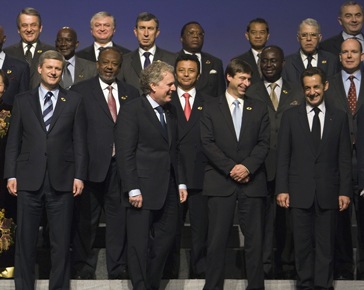
involved in this debate it’s too easy to see political influence working harder than common sense and economic relevance for the future. Keynes saw the future in terms of 100 years – what is their perspective?
We can only hope they minimise the shifts to those that will address the immediate problems, and take time about long term systemic changes.
Thoughts on this one, especially from any economist folks, couch or otherwise, welcome.
 Bankwatch