

Summarize
It was meant to happen once humans were regularly flying to Mars. Then the AI boom took off.
By Bailey Lipschultz, Loren Grush, Edward Ludlow, and Ryan Gould
June 12, 2026 at 9:46 PM EDT
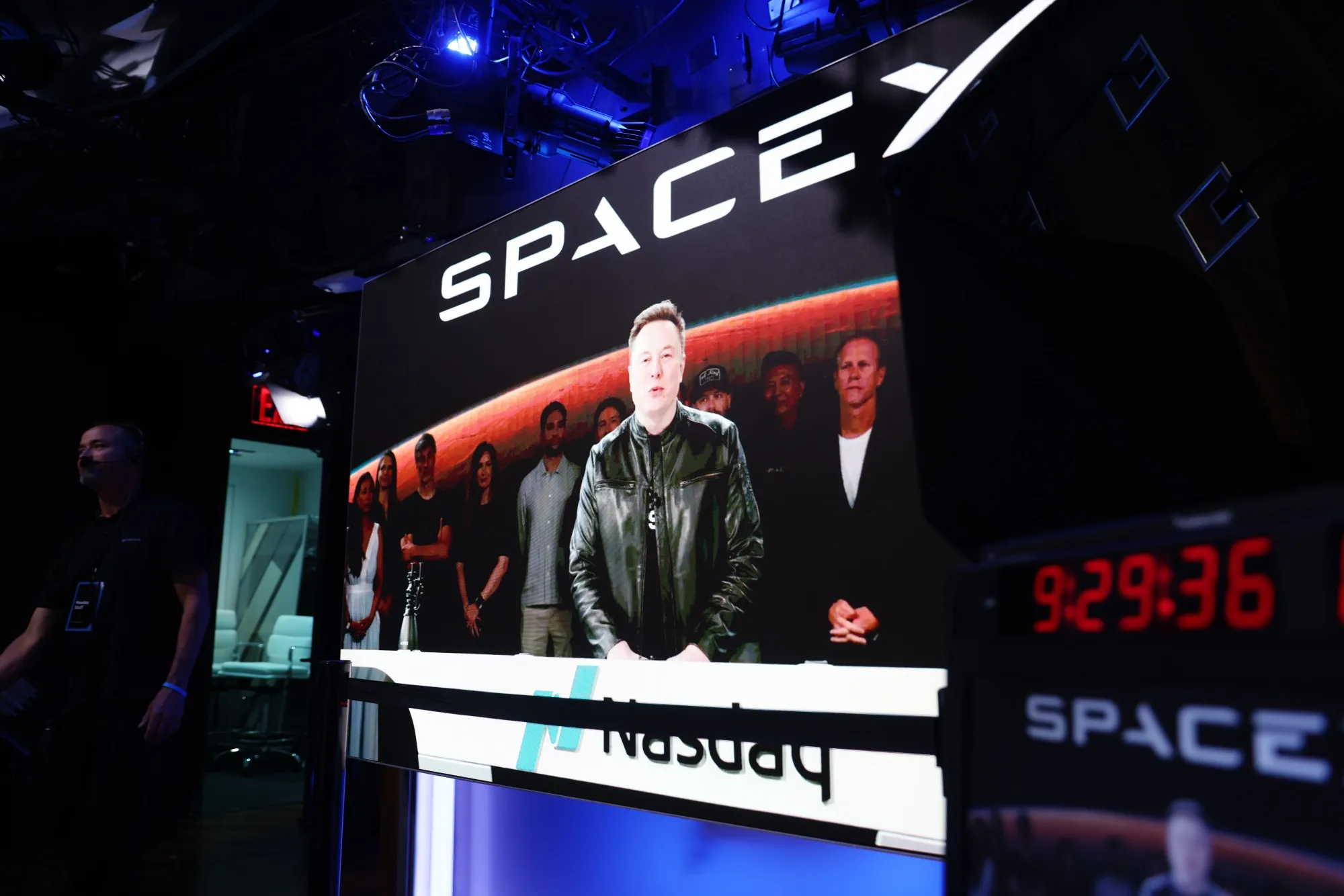
Elon Musk and his executives had one overarching message for the army of people working on the SpaceX initial public offering over the past six months: Faster, move faster.
As the gigantic space exploration startup barreled toward a public listing after 24 years as a private company, the urgency was apparent. The acquisition of a $250 billion artificial intelligence company in the middle of the process? Don’t let it slow you down. Why have everyone wait late into the evening for the final terms? Instead, close the deal during market hours.
The race culminated on Friday, when Space Exploration Technologies Corp. started trading on the Nasdaq after pricing the biggest IPO in history. The company raised $75 billion and made Musk the world’s first trillionaire. Shares climbed as much as 31% in their debut before closing at $160.95, giving SpaceX a fully diluted market value of $2.2 trillion.
This account of the IPO preparations is based on conversations with multiple people involved in the process, who asked not to be identified discussing private details. SpaceX didn’t respond to a request for comment.
Big Take
SpaceX and the Largest IPO in History
15:32
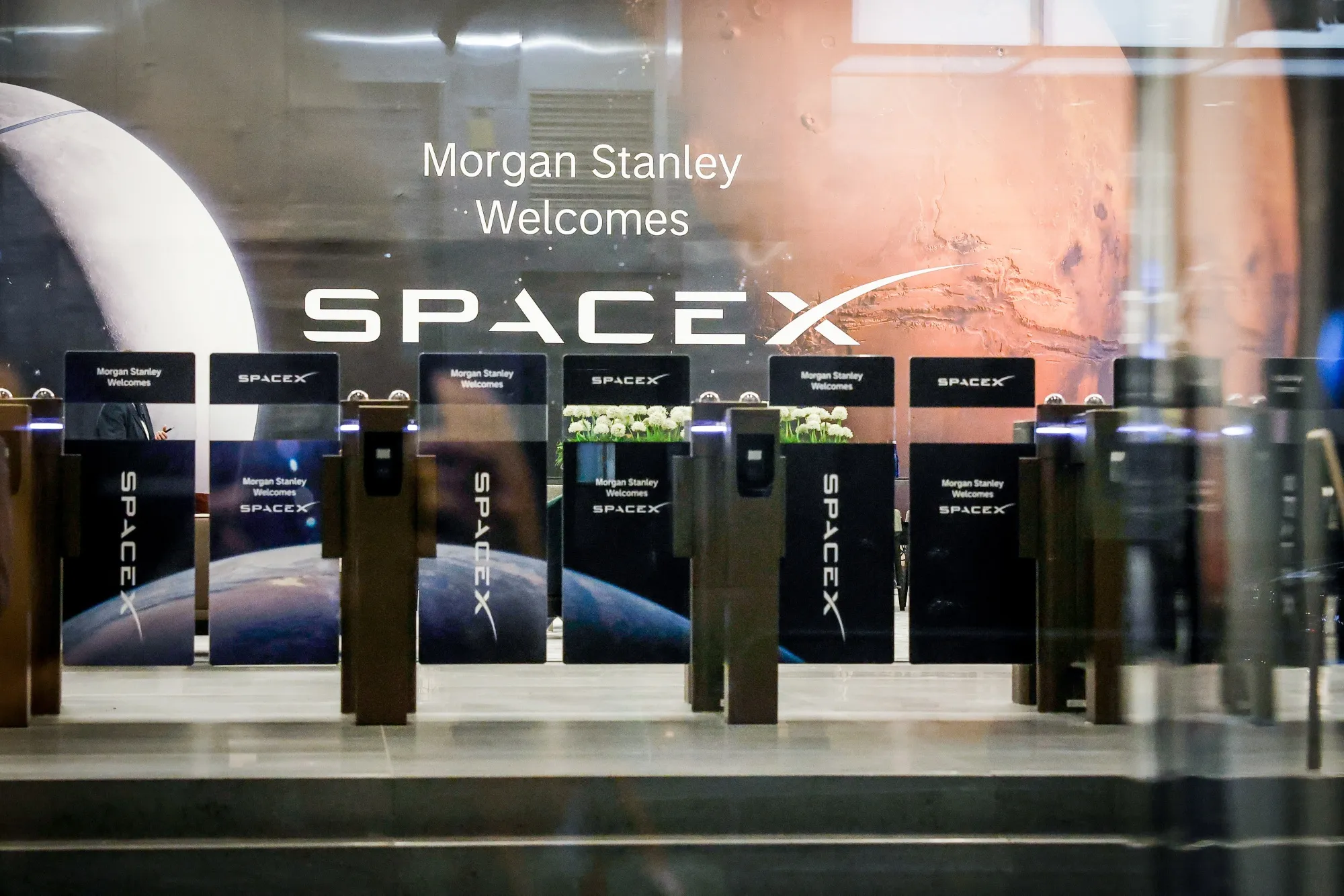
In the lead up to listing day, banks working on the deal decked out their New York offices with SpaceX promos, from rockets on the elevator doors at Morgan Stanley to rockets on pedestals in the lobby of Goldman Sachs Group Inc. For those who made it to Goldman’s 41st floor, the decorations made it look like they were viewing the Manhattan skyline from the surface of Mars.
On Friday, SpaceX Chief Financial Officer Bret Johnsen and President Gwynne Shotwell rang the opening bell on the Nasdaq trading floor while Musk did the same in front of thousands of employees and investors at the company’s headquarters in Starbase, Texas.
Goldman Sachs attendees decked out in custom Nike Inc. sneakers — green, in a nod to their so-called greenshoe allocation in the IPO — crowded around screens as the market opened. The shoes, according to people familiar with the matter, were Musk’s idea.
Read more: SpaceX Strikes Rare Deal to Pay $0 to Bankers for IPO Greenshoe
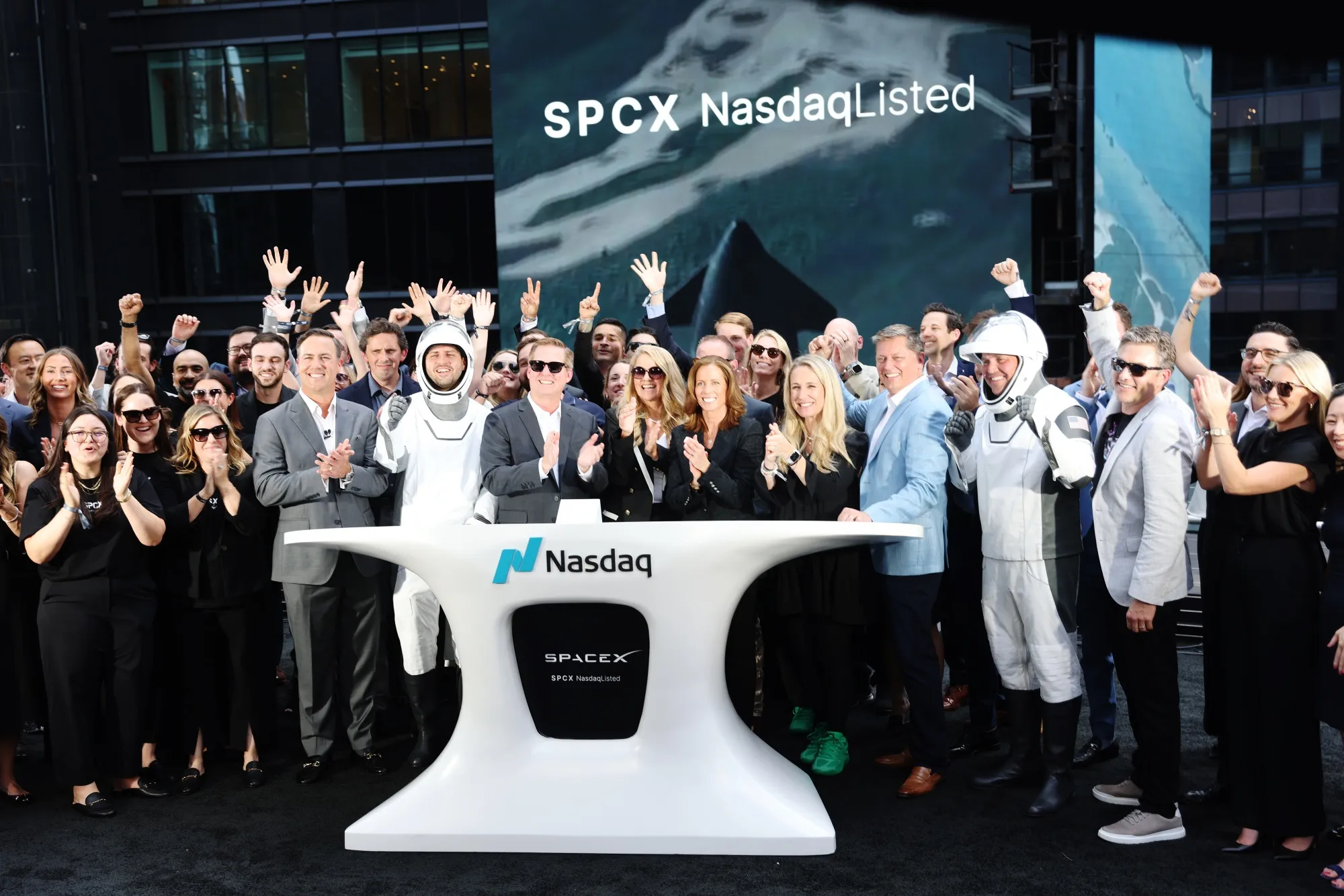
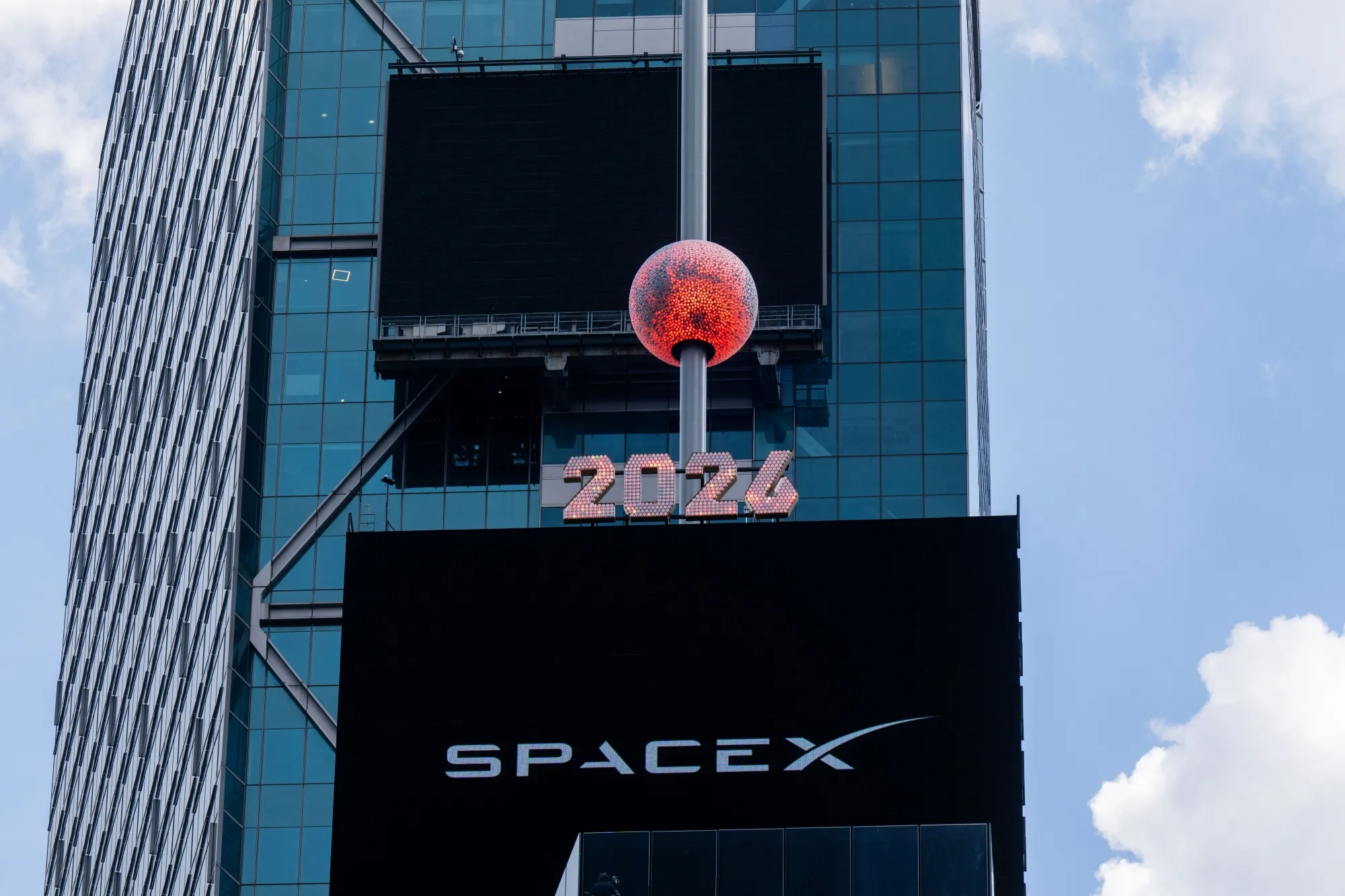
As trading drew to a close, executives and employees ventured out into the 90F (32C) afternoon and onto Nasdaq’s balcony overlooking Times Square, where the famous Times Square Ball had been lit up to glow red like Mars. Instead of dropping, as it does just before midnight on New Year’s Eve, it slowly ascended toward the sky.
“It is certainly hard to believe that a little company that started in a warehouse in El Segundo is now going public with the largest IPO ever,” Musk said before the bell ringing. “I gave SpaceX less than a 10% chance of succeeding at all.”
How SpaceX’s IPO Stacks Up
Top 100 global IPOs and similar listings since 2000, shown in 2026 dollars
Note: Top 100 by nominal offer size at the time of issuance. Excludes closed-end funds, REITs and companies with limited market capitalization data. Listings in multiple exchanges that were part of the same raise are merged into one entry. Includes overallotment (greenshoe) options where exercised. Market capitalization as of the end of the first day of trading. SpaceX’s figures are based on its IPO pricing on June 11 (offer size) and the market close on June 12 (fully diluted market value, accounting for stock options and restricted share units).
Source: Bloomberg
AI Pivot
From the early pitch meetings, when banks jostled for a role, to the official filing in May, SpaceX underwent one of the biggest periods of transition in its history.
In just a few months, the company made a hard pivot to artificial intelligence, combining with Musk’s own xAI. By then, advisers had already started drafting an IPO prospectus. An acquisition — which valued xAI at $250 billion and opened up a completely new line of business — changed the story.
Months later, Musk added another twist when SpaceX said it had an agreement that gave it the right to acquire artificial intelligence startup Cursor for $60 billion. For many, the deal came completely out of the blue.
Read more: SpaceX Is Planning to Buy Startup Cursor 30 Days After IPO
At the same time, Musk had started talking more and more about how SpaceX was going to build the vast data centers that would be needed to support AI. The unique selling point? The data centers would be in space, launched into low-Earth orbit by SpaceX’s massive Starship rockets.
To do that, especially in the four- to five-year timeframe that Musk had touted, would cost a colossal amount of money. An IPO was suddenly more of a necessity, even though executives had said for years that SpaceX would only go public once it was flying regularly to Mars. Earlier IPO discussions had focused only on spinning off Starlink, the company’s satellite internet service.
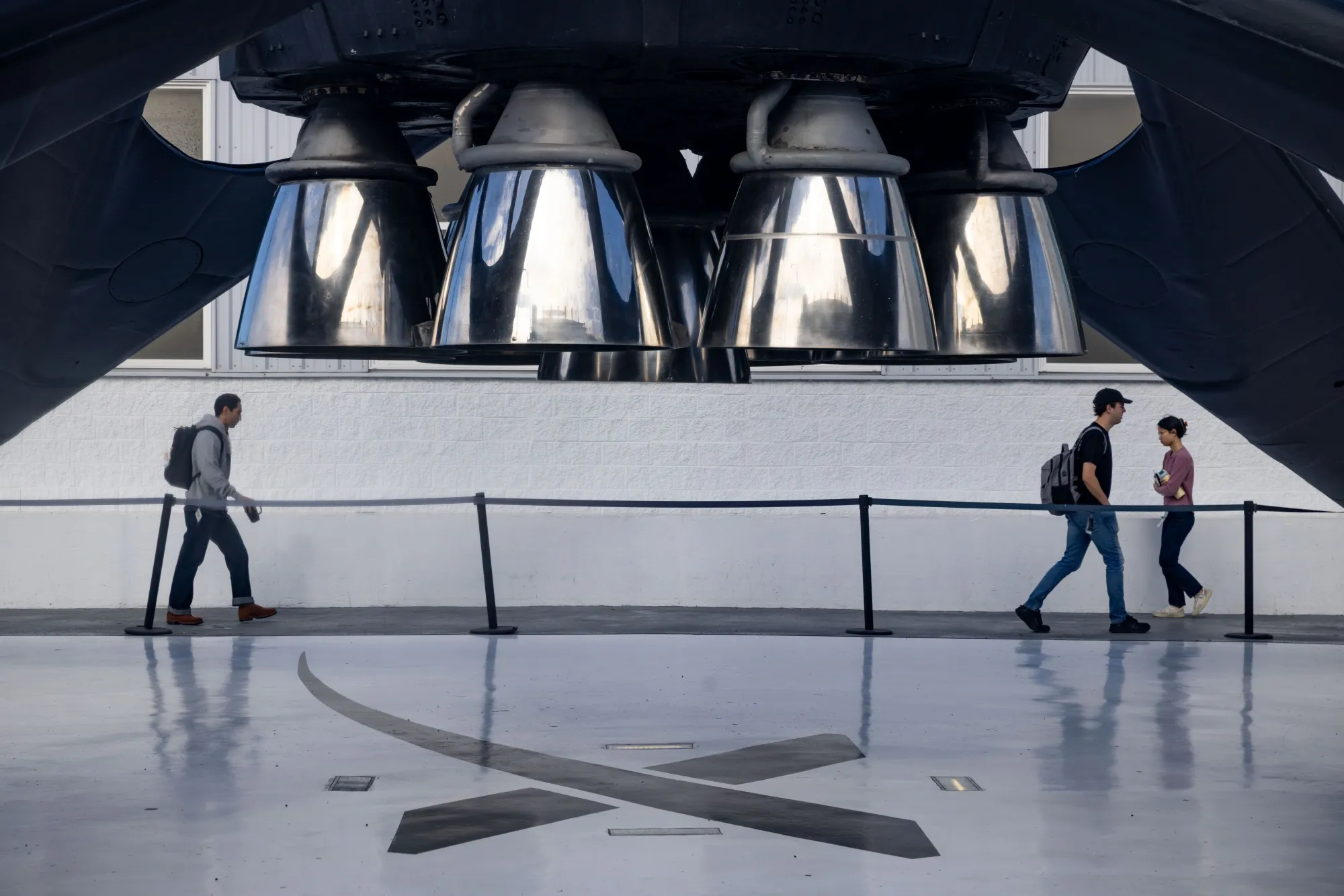
Now, in its IPO prospectus, SpaceX officially asked investors to come along for the AI ride, telling them it believed a $26.5 trillion addressable market exists for the technology and touting infrastructure such as the computing power the company planned to rent to competitors.
“They have become a new cloud AI infrastructure player overnight, and no one really saw this coming,” said Mandeep Singh, global head of technology research at Bloomberg Intelligence.
Read more: SpaceX Rented Out Computing After Own Teams Had Trouble Using It
Musk’s focus on SpaceX and AI has raised speculation among investors about the future of Tesla Inc., Musk’s other flagship public company. To avoid dividing investor attention, some analysts think a merger between the two firms could be coming.
SpaceX leapfrogged Tesla in market valuation as soon as its IPO priced. Many Musk fans are hoping it sees similar, if not greater, growth than the electric vehicle maker, given its broad ambitions. But SpaceX may end up plagued by the same valuation concerns that have dogged Tesla for years.
“There’s only about 15 companies that are worth a trillion dollars today,” said Rand Millwood, investment advisor at Guardian Wealth Advisors. “They’re very successful, cash flow positive, all those kinds of things, and that’s not SpaceX.”
Bank Meetings
Just about a week after the xAI deal, SpaceX gathered advisers at its former headquarters in Hawthorne, California, for an IPO kickoff meeting. Assembled in the room were a group of banks that had spent years building relationships with Musk and the company, partly in the hopes of scoring a coveted role on the IPO and the fees that would come with it.
Among them: Goldman Sachs, Morgan Stanley, JPMorgan Chase & Co., Bank of America Corp. and Citigroup Inc., each of which had won a mandate alongside more than 15 other bookrunners and co-managers who would eventually join the deal.
Morgan Stanley had long been seen as the banker to Musk, after sticking by him for years and keeping faith in his high-risk bid to acquire Twitter, now known as X. Morgan Stanley banker Michael Grimes, who drove the bank’s work on that deal, eventually followed Musk to Washington to work for the Trump administration. He returned to Morgan Stanley earlier this year.
But when SpaceX filed the prospectus publicly in mid-May, Goldman Sachs’ name was listed in the lead left position on the deal. Goldman CEO David Solomon has credited a 20-year relationship for the accolade, and told Bloomberg in early June that “there’s a lot of things that the team did over the last six months that contributed to the ultimate result.”
Read more: Goldman CEO Slides Into Musk’s DMs During Bid to Lead SpaceX IPO
After the early meetings, representatives of some of the banks spent much of their time in Hawthorne, often badging into SpaceX offices multiple times a week to keep the process on track. SpaceX’s Johnsen was an almost constant presence, overseeing the advisers and running decisions past Musk throughout.
SpaceX’s Long Run as a Private Firm Gives IPO a Boost
Pre- and post-IPO value for SpaceX and the Magnificent Seven
Note: Public market capitalizations are the values at year-end. Data for 2026 are values at the market close of June 12. SpaceX’s figure is the fully diluted market value, accounting for stock options and restricted share units. Figures account for inflation using the seasonally adjusted urban consumer price index for April 2026 from the Bureau of Labor Statistics. Valuation figures include estimates.
Sources: PitchBook, Bloomberg
Though the banks did a huge amount of work to pin down the company’s investor pitch and valuation, it was Musk and Johnsen who ultimately came up with the fixed price. Unlike a typical IPO, SpaceX set a single price for the stock rather than a potential range: shares would sell for $135, and there’d be 555.6 million of them available.
The decision was unprecedented for a US deal of this size but made the process faster and more transparent, including for retail traders, who Musk had long said should have access to any listing.
“I’m a huge fan of small retail investors. Will make sure they get top priority,” Musk posted in 2020, referring to what was then billed as a potential IPO of the Starlink business.
null
In the end, retail traders were allocated about $15 billion of shares, or about 20% of the total stock on offer. Individuals submitted more than $100 billion in orders, people familiar with the matter have said.
Matt Frank, 34, put in an order for 200 shares and received 23 in total. His dad got some too.
“I don’t have a target sell price,” Frank said in an interview. “I spoke to my dad who said he hopes to one day give these shares to his grandchildren, so I’m aligned with that as well.” He sat out trading on Friday.
After the market closed, SpaceX executives and employees — minus Musk — headed to JPMorgan’s offices in midtown Manhattan for a party hosted by the bank’s CEO, Jamie Dimon, where branded Tomahawk steaks were served. A little over a week before, JPMorgan held one of the first official SpaceX marketing events when Dimon chaired a Q&A with Musk, who appeared remotely via video while his mother watched from the audience.
“We’re embarking on a massive new growth phase,” Musk told Dimon during the livestream. “We need capital for that.”
On Friday, from Starbase, he struck a more reflective note, combined with his usual candor. “If people told me this was going to happen,” he said, referring to SpaceX holding the world’s biggest IPO. “I was like ‘man, you must be smoking some really good crack,’” he said.
— With assistance from Demetrios Pogkas, Jennah Haque, and Kiel Porter
 Bankwatch