

EU military independence 2026
EU military independence 2026 This article breaks down what the EU’s rearmament drive actually involves, why it is happening now, and what it means for NATO, global stability, and the future of the Western alliance.
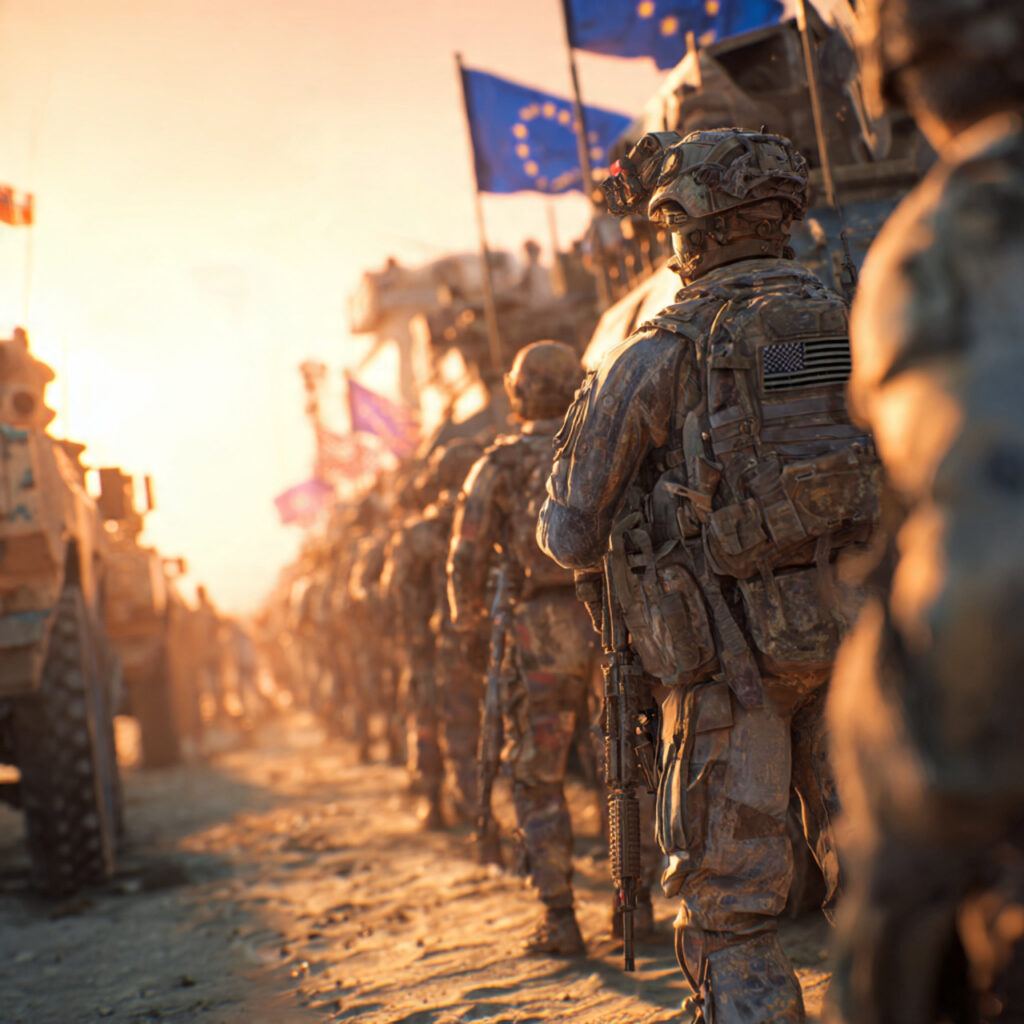
EU military independence 2026 Europe is undergoing its most significant military transformation since the end of the Cold War. In April 2026, the European Union is actively advancing its push for EU military independence, a sweeping strategic shift designed to reduce the continent’s reliance on the United States and NATO for its core security needs. Driven by geopolitical turbulence from the ongoing Russia-Ukraine conflict to rising tensions in the Indo-Pacific EU leaders are betting that strategic autonomy is no longer optional. It is existential.
This article breaks down what the EU’s rearmament drive actually involves, why it is happening now, and what it means for NATO, global stability, and the future of the Western alliance.
Why Europe Is Moving Toward Military Independence Right Now
The momentum behind Europe’s defense push is not new, but the urgency has intensified sharply in 2026. Several converging factors have made the status quo relying heavily on U.S. security guarantees through NATO feel increasingly fragile to European policymakers.
The Shifting U.S. Focus
Washington’s strategic attention has increasingly pivoted toward the Asia-Pacific region, particularly in managing competition with China. Ongoing trade tensions including the high tariff regime that has defined U.S.- Persistent Threat
Russia’s continued military aggression in Ukraine has made European defense a top-priority budget item for virtually every EU member state. The war has exposed capability gaps in ammunition stockpiles, air defense systems, and logistics that EU governments are now scrambling to address through coordinated spending.
Political Instability in Key Allied Nations
Political turbulence in several NATO member states has added another layer of uncertainty. EU strategists are factoring in the possibility that domestic political shifts in allied nations could complicate defense cooperation, making a more self-reliant European defense structure a strategic necessity.

What Europe’s 2026 Defense Strategy Actually Involves
The EU’s rearmament blueprint is not a single document but a cluster of overlapping initiatives being pursued simultaneously across Brussels and member state capitals.
A Unified Air Defense Layer
One of the flagship proposals being discussed is a pan-European air defense shield sometimes referred to informally as the “Euro-Shield” — that would integrate national systems into a coherent continental network. The goal is to create an interoperable system using primarily European-manufactured technology, reducing dependence on U.S. defense platforms for critical infrastructure protection.
A Rapid Reaction Force
EU defense planners are developing a standing rapid reaction force proposed at approximately 50,000 personnel that could be deployed autonomously in regional crises, particularly in the Mediterranean basin and Eastern Europe, without requiring full NATO consensus for activation.
A European Defense Industrial Base
Perhaps the most consequential element is the economic dimension. The 2026 strategy pushes for a significant portion of new defense procurement to remain within the EU internal market. This is fueling rapid growth in Germany’s, France’s, and Poland’s defense technology sectors, creating what some analysts have called a new “European defense industrial revolution.”
A Permanent Joint Headquarters
Brussels is also advancing plans for a permanent EU military planning and command headquarters. This body would coordinate logistics, joint exercises, and operational planning for non-Article 5 missions — situations where NATO’s mutual defense clause is not triggered but European security interests are at stake.
What This Means for NATO and Transatlantic Relations
European officials are careful to frame the EU defense push as complementary to NATO, not a replacement for it. In formal statements, Brussels maintains that a stronger European defense pillar will make the Atlantic alliance more effective overall.
However, analysts note an unavoidable tension. Building a parallel European command structure — even for non-Article 5 operations creates the institutional muscle memory for fully independent European action. Over time, this could subtly shift the political calculus around when and whether to involve NATO at all.
For smaller EU member states, the economic logic is also compelling. Pooling defense procurement through EU mechanisms allows nations with constrained budgets to access high-end capabilities from advanced missile defense to cyber command infrastructure that would be unaffordable on a purely national basis.
The Bigger Geopolitical Picture: Europe as a Third Pole
Beyond the immediate security calculus, the EU’s military independence drive reflects a broader ambition: to position Europe as an independent geopolitical actor a so-called “third pole” in a world increasingly shaped by U.S.-China competition.
A more militarily self-sufficient EU would, in theory, have greater leverage to engage in diplomacy without relying on Washington’s backing. This could give Brussels more independent influence in active conflict zones and regional disputes from the Middle East to the South Caucasus.
The cyber dimension is also central to this vision. EU planners are developing a unified cyber-command framework to protect the Eurozone’s financial systems, energy grids, and critical infrastructure from state-sponsored attacks a domain where current European capabilities remain fragmented.

Conclusion: The Era of European Strategic Responsibility
April 2026 marks a genuine inflection point in European security history. The EU’s push for military independence is not a rejection of the transatlantic alliance it is an acknowledgment that Europe must be capable of shouldering more of its own defense burden in an increasingly unpredictable world.
Whether Brussels can translate ambitious policy papers into operational military capability remains the central question. The political will, the budget lines, and the industrial foundations are taking shape. The “Sovereign Europe” that strategists have debated for decades is no longer a distant theoretical concept it is becoming an active geopolitical project.
For readers following European affairs, defense policy, or global security trends, the developments unfolding in Brussels in 2026 deserve close and sustained attention.
Logged in as Guest
Related News

EU military independence 2026
April 10, 2026 | by mavia fazal
Friday, Aprail, 2026 Trusted by millions worldwide Back to News polotics Europe Defense Strategy 2026: EU Moves Toward Independent Security…

US-China tariff 2026
April 10, 2026 | by mavia fazal
Friday, Aprail 10, 2026 Trusted by millions worldwide Back to News Polotics US-China Trade Clash 2026: New Tariff Threats Shake…
 Bankwatch