Coreweave joins ‘hyperscaler’ group


Research: CoreWeave’s AI Infrastructure and Market Position They have particular differentiation in 3. Infrastructure Differentiation. it is designed explicitly to operate with GPU infrastructure, and seed investment from Nvidia cements this. They have been around for eight years(8) years but still have startup characteristics. Their debt profile is high and rates are astronomic. They are working with Bank of America to refinance $1.5Bn debt. Their efforts in Spain are spectacular and Spain in particular is in dire need of high tech support. The facility was inaugurated today by the Mayor of Barcelona, Jaume Collboni, and Albert Tort, Secretary of Telecommunications and … Continue reading Coreweave joins ‘hyperscaler’ group

UPDATED Mar 05/ 25: The Evolution of Human Thought ….


and the Emergence of AI: A Historical Synthesis Abstract This report traces humanity’s evolving relationship with reality, knowledge, and reason from antiquity to the digital age, culminating in the rise of artificial intelligence (AI). Across epochs, societies have grappled with the tension between faith, reason, and technological innovation, each era refining—or contesting—the role of human cognition in shaping understanding. The classical world elevated reason and idealized forms; medieval theology subordinated inquiry to divine revelation; the Renaissance and Enlightenment recentered human agency and empirical observation. Modernity’s scientific revolutions destabilized classical physics and philosophy, revealing reality’s inherent subjectivity. Today, AI challenges the … Continue reading UPDATED Mar 05/ 25: The Evolution of Human Thought ….

The Concept of Freedom: Origins and Evolution


Ancient Foundations The concept of freedom has its roots in ancient civilizations, particularly in classical Greece and Rome. In these early societies, freedom was primarily understood as a political concept closely tied to democratic self-rule and participation in civic life[1][3]. Greek City-States The Greek city-states, especially Athens, developed a notion of freedom that emphasized: Liberation from political bondage Participation in democratic decision-making Self-rule by male citizens This conception of freedom was inherently collective, focusing on the ability of citizens to govern themselves rather than individual rights[1]. Roman Republic The Roman Republic continued and expanded upon the Greek ideal of political … Continue reading The Concept of Freedom: Origins and Evolution

We Need a New Science of Progress


Humanity needs to get better at knowing how to get better. By Patrick Collison and Tyler Cowen July 30, 2019 In 1861, the American scientist and educator William Barton Rogers published a manifesto calling for a new kind of research institution. Recognizing the “daily increasing proofs of the happy influence of scientific culture on the industry and the civilization of the nations,” and the growing importance of what he called “Industrial Arts,” he proposed a new organization dedicated to practical knowledge. He named it the Massachusetts Institute of Technology. Rogers was one of a number of late-19th-century reformers who saw that the United … Continue reading We Need a New Science of Progress

August Cole is an author exploring the future of conflict through fiction and other forms of “FICINT” storytelling.


L His talks, short stories, and workshops have taken him from speaking at the Nobel Institute in Oslo to presenting at SXSW Interactive to tackling the “Dirty Name” obstacle at Fort Benning. With Peter W. Singer, he is the co-author of the best-seller “Ghost Fleet: A Novel of the Next World War” (2015) and “Burn In: A Novel of the Real Robot Revolution” (2020). He is a non-resident fellow at the Brute Krulak Center for Innovation and Creativity at Marine Corps University and a non-resident senior fellow at the Brent Scowcroft Center on Strategy and Securityat the Atlantic Council; he directed … Continue reading August Cole is an author exploring the future of conflict through fiction and other forms of “FICINT” storytelling.

Nature stress test: Assessing exposure of five African banking systems


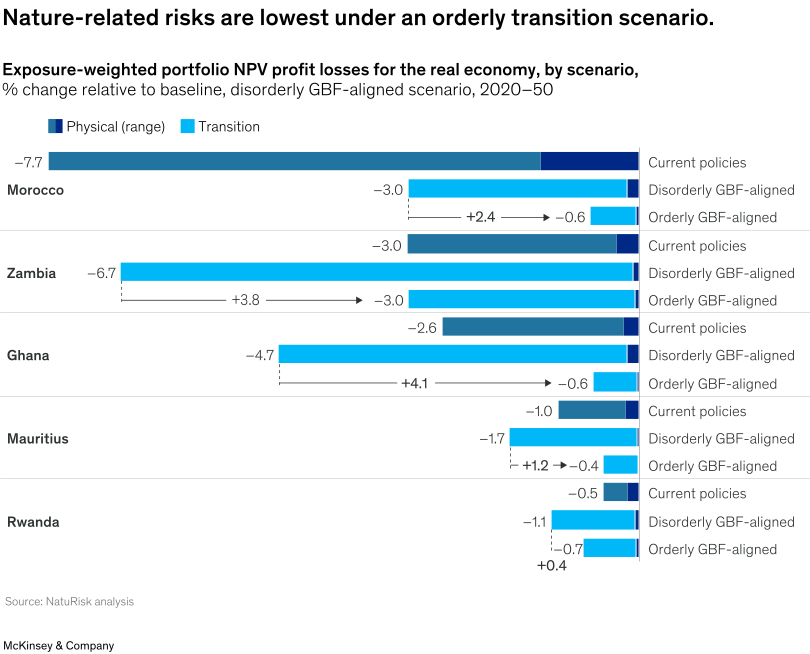
July 16, 2024 | Report By Charlie Dixon and Jason EisShare PrintDownload Nature-related risks are impacting Africa’s natural ecosystems and economy. An enabling environment could accelerate action from Africa’s private financial sector to manage risks and opportunities. DOWNLOADS Full Report (50 pages) Africa is both heavily dependent on nature and experiencing rapid nature loss. Some 62 percent of African GDP is moderately or highly dependent on the services that nature provides and 70 percent of communities in sub-Saharan Africa depend on forests and woodlands for their livelihoods.1 In parallel, momentum is building in the African financial sector in response. This new joint report by McKinsey Sustainability … Continue reading Nature stress test: Assessing exposure of five African banking systems

Ben Casselman NYT


What I Cover: “particularly interested in the long-term trends — demographic, geographic, technological, political — that shape the way we live and work.” I’m a reporter covering the U.S. economy for The New York Times. I’m an unapologetic econ nerd. I love reading research papers, debating the effect of policies and diving deep into economic data to find stories. But what I really care about are people — economic models matter only if they teach us something about the real world. My Background I have been reporting on the economy in one way or another for nearly 20 years. I … Continue reading Ben Casselman NYT

David Swensen Death: Yale Endowment Leader Transformed Investing – Bloomberg


Like Warren Buffett, Yale’s renowned endowment manager David Swensen held outsize sway over a generation of investing. But does his legacy hold up today? — Read on http://www.bloomberg.com/opinion/articles/2021-05-07/david-swensen-death-yale-endowment-leader-transformed-investing David Swensen, who ran Yale University’s endowment since 1985 and transformed investing in the process, died of cancer on Wednesday at the age of 67. Always dedicated to his alma mater, where he received a doctorate in economics, he taught his last class on Monday. When Swensen took over the Yale endowment, it was worth a little more than $1 billion. It grew under his watch to $32 billion even as it made regular … Continue reading David Swensen Death: Yale Endowment Leader Transformed Investing – Bloomberg