
A Theoretical Model and Empirical Results Linking Website Interactivity and Usability Satisfaction


The title of this paper is terribly academic, but the premise is not. Interactivity increases user satisfaction and trust in your web site. SSRN-A Theoretical Model and Empirical Results Linking Website Interactivity and Usability Satisfaction by Paul Lowry, Trent Spaulding, Taylor Wells, Gregory Moody, Kevin Moffit, Sebastian Madariaga Results indicate that interactivity is successfully able to increase website satisfaction. Finally, implications for practitioners, limitations of the study, and directions for future research are addressed. This is highly significant for banks, because our sites are text heavy, and generally low on the interactivity scale. The exception is online banking, and interestingly … Continue reading A Theoretical Model and Empirical Results Linking Website Interactivity and Usability Satisfaction

The Merchant-Bank Struggle for Control of Payment Systems


Courtesy of Aneace, here is a paper on the evolution of the payment systems. Aneace’s Blog: The Merchant-Bank Struggle for Control of Payment Systems …… article written by attorney Adam Levitin, titled The Merchant-Bank Struggle for Control of Payment Systems, published in the September issue of the Journal of Financial Transformation.The article reviews the factors behind the struggle between merchants and banks, and explores the potential impact of new payments technologies and structural changes such as MasterCard’s IPO. The conclusion in the paper, is that two broad forces are at play that are changing the payment landscape. critical mass of … Continue reading The Merchant-Bank Struggle for Control of Payment Systems

Our world has evolved into one with amazingly powerful “edge” devices


This paragraph is immensely powerful in its implications. I am reading Ray Ozzie’s financial analysts speech. I have been critical before of Ray, and his impact on Microsoft. I have moved to “on the fence”. This is an analyst speech, and I don’t know yet who wrote it. But if 50% of this makes its way into the Microsoft DNA, then that can only be good for the company. MSFT Financial Analyst Meeting: Ray Ozzie As an industry we’ve talked about the power of massive centralized data centers as long as I can remember, from Ted Nelson’s Xanadu to all … Continue reading Our world has evolved into one with amazingly powerful “edge” devices

Are you ready to change everything? – Vancity social network site


I just registered and had a look around Vancity’s social network site and I am highly impressed. Are you ready to change everything? | ChangeEverything.ca Welcome to ChangeEverything.ca, the site for people who want to change themselves, their communities or their world. We’re still putting the finishing touches on our design and making sure all the lights and buzzers work, but we’re glad you’re here — and we hope you’ll jump right in. Things I liked: its a hosted blog site without calling itself that – its very user friendly encouraging people to get engaged. There is loads of upside … Continue reading Are you ready to change everything? – Vancity social network site

Microsoft – Financial Analyst meeting 2006


In what I believe is the first major speech from Ray Ozzie, since he took over the Chief Software Architect role from Bill Gates, he lays out some ideas of his vision.  As Banks, we use their products, and our customers are impacted by their services.  Our competitors are facilitated by their services.  Worth the read. MSFT Financial Analyst Meeting: Ray Ozzie As many of you are already pretty aware, I strongly believe that Internet services will play a very important role for Microsoft moving forward. So I thought I’d devote my entire time with you today on that specific … Continue reading Microsoft – Financial Analyst meeting 2006

More on MySpace marketing


Following the review of the eMarketer piece on MySpace marketing, here is more from Economist. Economist.com | Articles by Subject | Marketing on MySpace THE internet sensation that is MySpace continues to grow at an astonishing rate. The social-networking site had 17m unique monthly visitors last July, when Rupert Murdoch recast himself as an internet visionary by buying it for $580m; now it has 54m, and is the most visited website in America. Even if, judging by recent headlines, many visitors are prowling paedophiles or panicking parents spying on their sex-crazed children, at least some of them are the valuable … Continue reading More on MySpace marketing

The new number one -Bank of America


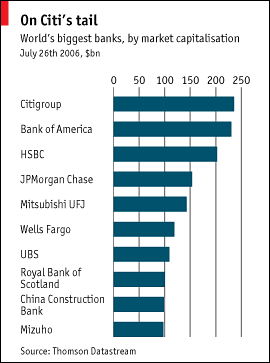
Bank of America takes number one position in FI profitiability, and almost number one in market cap.

Economist.com | Articles by Subject | Bank of America

Jul 27th 2006 | CHARLOTTE
From The Economist print edition

SENIOR employees of Bank of America (BofA) packed into the auditorium at the company’s headquarters in Charlotte on July 20th. They had gathered to hear Kenneth Lewis, the chief executive, deliver a long-awaited message: thanks to BofA’s earnings of $5.5 billion in the second quarter, they now worked for the most profitable financial institution in the world. To cheers, he added: “It was nothing personal; Citi just got in the way.”

cfn115.gif

Continue reading “The new number one -Bank of America”

Social networks, and marketing


Courtesy of emarketer.com, a review of marketing and social networks. The main message is that that social networks have become mainstream over the last year, and are now an embedded feature of online. Piper Jaffray sum it up; “We believe social networking sites are not only one of the fastest growing web destinations, but also they have reached a critical mass where they cannot be dismissed as fads and instead have become a permanent part of the fabric of web applications.” —Piper Jaffray’s “Silk Road” commentary, June 5, 2006″ Emarketer lay out three types of social network sites; 1) Specialsed … Continue reading Social networks, and marketing

Financial Services Online Marketing predicted to grow slower than overall


It seems that Bankers do not predict growth relative to the rest online advertsing. I wonder if this is attributable to the belief that internal marketing is of greater value to increase share of wallet. In general I think this really means that Banks are unsure of the future and are making linear predictions. eMarketer.com – Financial Services Online Marketing Financial services is one of the largest advertising categories on the Internet. In 2005, it accounted for 12% of all US online advertising, about $1.5 billion of the $12.5 billion total. No matter which way the stock markets go, consumers … Continue reading Financial Services Online Marketing predicted to grow slower than overall

There’s no such thing as bad customers


The Wells philosophy is the epitome of customer centricity. Business 2.0: Bank different – Jun. 12, 2006 Wells Fargo CEO Dick Kovacevich tells Business 2.0 Magazine that there’s no such thing as bad customers – just companies that don’t work hard enough to turn them into good ones.…he argues, if a customer is truly unprofitable, that’s the company’s problem, not the customer’s. Their approach follows Aneace’s philosophy of treating each interaction, as an opportunity. Every transaction is an opportunity to engage a customer – both to satisfy a transactional need and also to sell him something. And the transaction  actually … Continue reading There’s no such thing as bad customers