
Odd Lots: The Hidden Forces Driving the Big Market Sell-Off Odd Lots The Hidden Forces Driving the Big Market Sell-Off https://podcasts.apple.com/ca/podcast/odd-lots/id1056200096?i=1000664111117 41:28 The Nasdaq is now in correction territory and the S&P 500 is down more than 2% so far this month. Analysts are blaming any number of things for the selloff, including a slowdown in the economy, the Federal Reserve being behind the curve on rate cuts, hedge funds rotating out of positions, and waning enthusiasm for AI. But Matt King, the former Citigroup strategist who’s now founded his own research shop called Satori Insights, argues there’s something else … Continue reading

Writing , cataloguing and effective archival
Every once in a while I go through an existential crisis in this area. it usually comes about due to the mammoth collection of folders and files which generally work for saving but are horrible for access and retrieval. Over the last few months I have installed the PARA method (projects, areas, resources, archival) in my Mac Notes and hard drive. this is a great first step but now my crisis has moved deeper to standards for input and methods of retrieval. And so enter Roam Research. I have tried them all except Roam, and in parallel the methods of … Continue reading Writing , cataloguing and effective archival
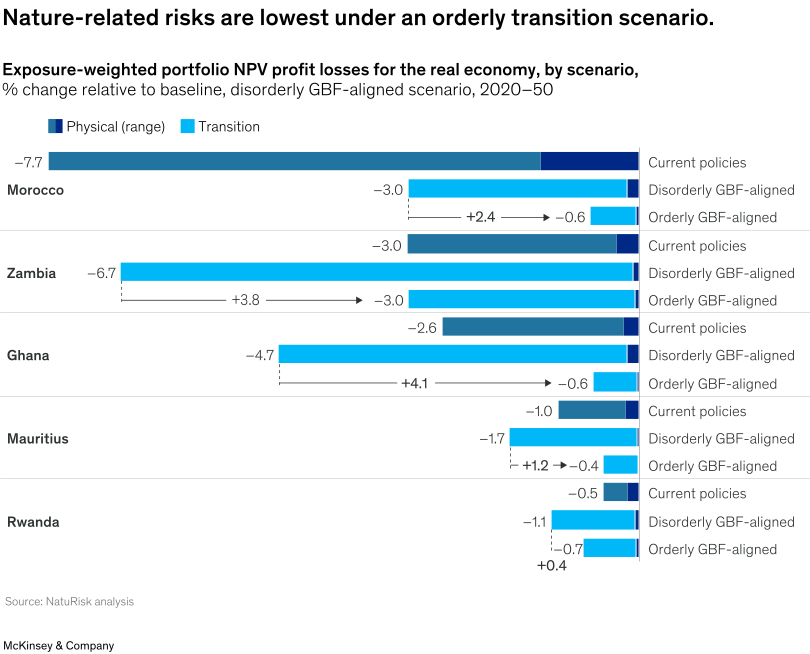
Nature stress test: Assessing exposure of five African banking systems
July 16, 2024 | Report By Charlie Dixon and Jason EisShare PrintDownload Nature-related risks are impacting Africa’s natural ecosystems and economy. An enabling environment could accelerate action from Africa’s private financial sector to manage risks and opportunities. DOWNLOADS Full Report (50 pages) Africa is both heavily dependent on nature and experiencing rapid nature loss. Some 62 percent of African GDP is moderately or highly dependent on the services that nature provides and 70 percent of communities in sub-Saharan Africa depend on forests and woodlands for their livelihoods.1 In parallel, momentum is building in the African financial sector in response. This new joint report by McKinsey Sustainability … Continue reading Nature stress test: Assessing exposure of five African banking systems
UK and Global Food Security in the Era Of ‘Permacrisis’
UK and Global Food Security in the Era Of ‘Permacrisis’ — Read on rusi.tandfonline.com/doi/epdf/10.1080/03071847.2024.2343726 Continue reading UK and Global Food Security in the Era Of ‘Permacrisis’
Market Selloff: Fed May Have Played the Rate-Cut Waiting Game Too Long – Bloomberg
What a difference a day makes. After rising on expectations of a September rate cut, stocks sell off after a slew of data points to recession. — Read on http://www.bloomberg.com/opinion/articles/2024-08-02/market-selloff-fed-may-have-played-the-rate-cut-waiting-game-too-long Continue reading Market Selloff: Fed May Have Played the Rate-Cut Waiting Game Too Long – Bloomberg

Microsoft’s AI Dreams not aligned with productivity growth timing expectations
Microsoft’s AI Dreams Make for an Expensive Reality. This challenge has hit home for Alphabet, Meta, Amazon too. These companies will need smaller incremental gains in Productivity to develop confidence in AI as an Industrial Revolution game changer. Continue reading Microsoft’s AI Dreams not aligned with productivity growth timing expectations

Levels of Thinking: How to Make Better Decisions with Second-Level Thinking
Anne-Laure Le Cunff • Reading time: 4minutes Skipping meals to save time, but finding yourself exhausted and unproductive by the afternoon. Choosing a cheaper apartment to save money, but the long commute ends up costing you time and energy. You tried to make the most sensible choice, and yet… What went wrong? It’s easy to get carried away when making a decision. We look at the current situation and extrapolate what we consider to be the most likely future outcome. But we often fail to consider the complex ramifications of the decisions we make. For instance, let’s say you’re offered a job … Continue reading Levels of Thinking: How to Make Better Decisions with Second-Level Thinking
Today’s Points:
The Fed is still on course to cut rates in September — and trying not to seem overeager. Animal spirits return: lowest 10-year yield in six months, biggest gain for the Nasdaq 100 in 18 months. BUT: The Bank of Japan’s hawkish turn has sunk the carry trade. Critical question is whether it’s allowed to kill the corporate zombies. Almost unnoticed, the Middle East situation is its most dangerous in a year — an oil spike would be a game changer. AND: More zombies. Continue reading Today’s Points:

Live Updates: The Fed Hinted That Rate Cuts Could Come Soon
The Federal Reserve left its benchmark interest rate unchanged at a two-decade high but suggested that recent progress in lowering inflation could enable it to cut interest rates soon. Updated July 31, 2024, 2:49 p.m. ET6 minutes ago Pinned Federal funds target rate Federal Reserve officials left interest rates unchanged at their July meeting, as economists had expected, and hinted that recent progress in lowering inflation could enable them to cut interest rates soon. The Fed decided on Wednesday to hold interest rates steady at about 5.3 percent — a two-decade high where they have remained for a year now. … Continue reading Live Updates: The Fed Hinted That Rate Cuts Could Come Soon

Microsoft Profit Jumps 10%, but Cloud Computing Grows Less Than Expected
The tech giant’s revenue also grew 15 percent, but Wall Street is watching whether its investment in A.I. is paying off for its cloud computing business. July 30, 2024 By Karen Weise Karen Weise has covered Microsoft since 2018. Microsoft closed its first full fiscal year of aggressive artificial intelligence investment with a mixed bag of results for people worried about how much big tech companies are spending on A.I. Sales from April through June hit $64.7 billion, up 15 percent from the same period last year, the company reported on Tuesday. Profit rose 10 percent, to $22 billion. The results … Continue reading Microsoft Profit Jumps 10%, but Cloud Computing Grows Less Than Expected

