
Bankwatch · June 8, 2026
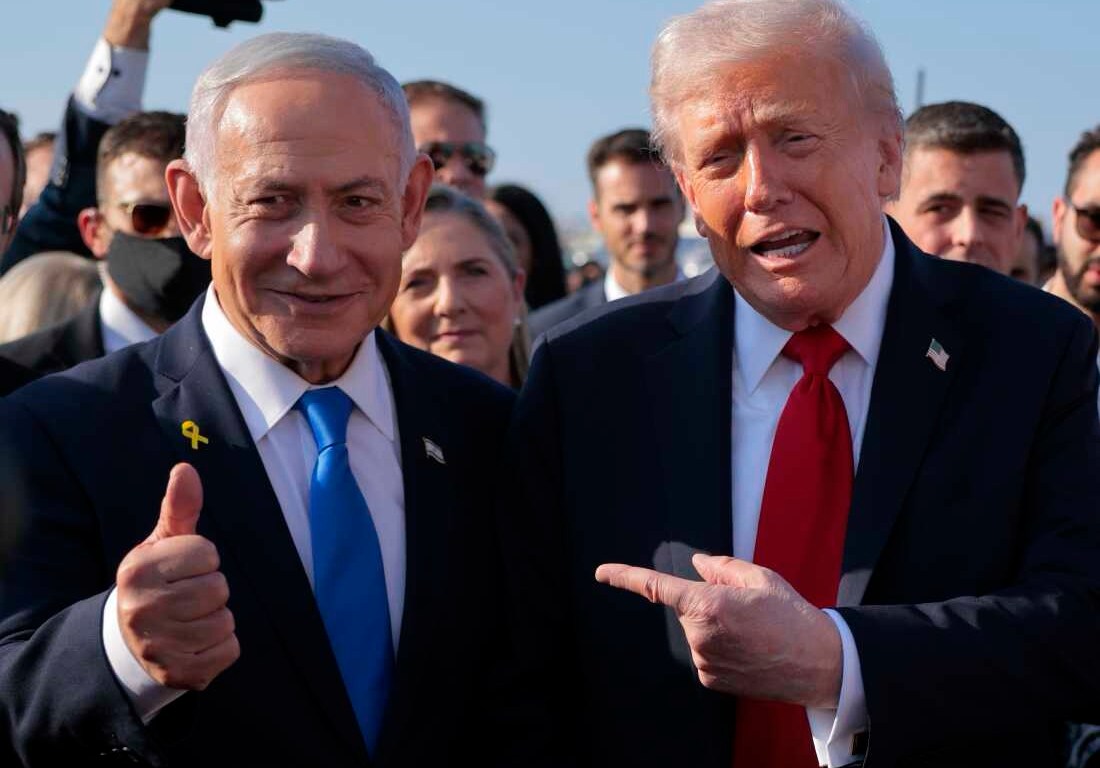
There is a pattern in how the Trump administration communicates about the Middle East that is worth naming plainly: Israel’s war strategy never appears in it.
Not on Truth Social. Not in Oval Office press remarks. Not in the public posture of the Secretary of State. The US comments on Iran, on ceasefire timelines, on nuclear disposition, on Gulf ally security guarantees. It does not comment on what Israel is doing in Lebanon and Beirut. That omission is not accidental. It is the operational core of the relationship.
Three Positions That Cannot Coexist Honestly
This week produced a useful compression of the contradiction. Within the space of 72 hours:
Trump told reporters that Iran had been “provoked” into its missile strikes on Kuwait — “some people would say they were slightly provoked, because we took a strong action for a different reason.”
Trump urged Netanyahu publicly to avoid “retaliatory action” against Iran, framing the exchange as a cycle both sides should step back from.
Rubio simultaneously condemned Iran’s attacks on Kuwait to the Kuwaiti foreign minister as “outrageous and unacceptable,” reaffirming US commitment to Kuwait’s security.
These three positions cannot coexist in a coherent foreign policy. Iran is simultaneously provoked (Trump), condemned (Rubio), and the target of Israeli action the US president is urging restraint on — while the Israeli strikes on Beirut that preceded the Iranian response go unmentioned by anyone in the administration.
The incoherence is not a communications failure. It is a structural feature. Trump holds negotiating space with Tehran by softening Iran’s culpability in public; Rubio holds the Gulf alliance together by condemning Iran to Gulf foreign ministers; and Israel’s Lebanon operations — the operational context that generates Iranian responses — are simply not part of the US public record.
The Architecture of Exclusion
The Washington ceasefire framework agreed June 3–4 between Israel and Lebanon illustrates the mechanism precisely.
Hezbollah was not at the table. That was Israel’s condition, and the US accepted it as the starting geometry. The agreement required a “complete cessation” of Hezbollah fire and a demilitarized zone in southern Lebanon — with Israel retaining unilateral strike rights to enforce compliance. Hours after the agreement was announced, Israel launched fresh attacks. Hezbollah’s leader Naim Kassem rejected the terms as “surrender.” A UNIFIL peacekeeper was killed by mortar fire in southeastern Lebanon the same week.
Hezbollah’s rejection is now framed in Western coverage as Hezbollah’s intransigence. The more precise description is that it was the predictable outcome of a deal structured to exclude them from its design while requiring their submission to its terms.
Lebanon’s president Joseph Aoun called the Washington framework the “last chance” for a comprehensive truce. The Trump administration said nothing about the Israeli strikes that continued through and after the agreement’s announcement. Truth Social was silent on Beirut.
The Free Hand
This is the core of what Mearsheimer and Walt identified and what this conflict is demonstrating in real time: the mechanism of US-Israeli alignment is not that the US always does what Israel wants. It is that US diplomatic architecture is shaped such that Israeli operational red lines become the starting geometry of any framework — and Israeli military operations outside that framework are simply not subject to US public comment.
The Gaza precedent established this clearly enough. The Lebanon iteration is more pointed because the disparity is now visible within the US government itself. Rubio and Trump are not saying the same thing about Iranian culpability. What resolves the contradiction is not a coherent position — it is the outcome. Lebanon bombing continues. Hezbollah is required to disarm as a precondition of any deal. Israel’s northern military campaign proceeds without a single Truth Social post naming it.
Every US administration since 2006 has managed some version of this exemption. The Biden administration maintained it through the 2024 Lebanon campaign. The Trump administration has formalised the silence — not through policy documents, but through consistent omission in the one communication channel the president controls directly and personally.
Why This Week Is Sharper
The “provoked” formulation is notable because it is Trump speaking without diplomatic preparation — an Oval Office remark, not a crafted statement. It exposes the actual operating assumption: that Iran’s responses to Israeli and US strikes are contextually understandable even when strategically condemned. That is the logic of a negotiator, not an ally. It suggests Trump is holding space for a Tehran deal that would require some acknowledgment of Iranian grievance.
But that logic has a structural ceiling: any deal that requires constraining Israel’s Lebanon operations is a deal the US diplomatic architecture cannot produce, because producing it would require the US to name publicly what Israel is doing and evaluate it on its merits. That is what no administration has been willing to do.
The silence on Beirut is not a gap in coverage. It is the policy.
Bankwatch publishes independent analysis on geopolitics, financial risk, and structural technology transitions.

