

Summarize
Qorvis worked for companies that authorities say are overseen by sanctioned kingpins. The firm says it doesn’t take sanctioned money.
Ben BartensteinSeptember 10, 2026 at 5:00 AM EDT
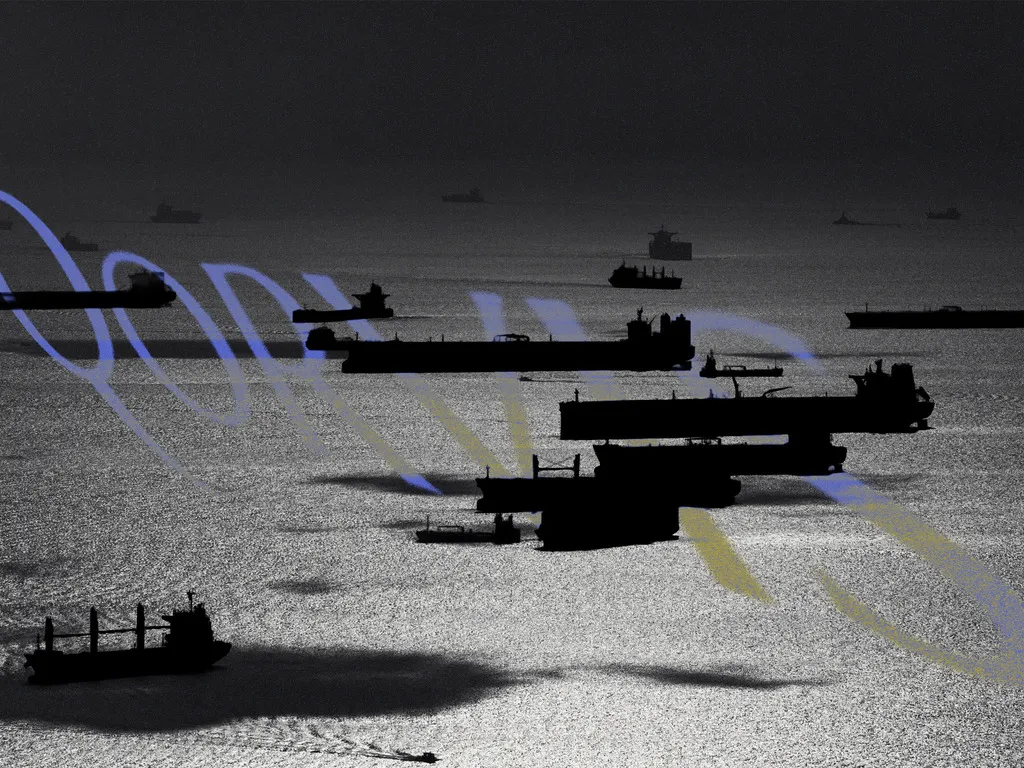
In early March, as the war in Iran sent oil prices soaring above $100 per barrel, executives at a Washington-based lobbying firm called Qorvis made an unusual suggestion to senior US officials, according to people familiar with the matter: The Trump administration should relax some sanctions on Iran and Russia to help stabilize the market.
Within days, the Treasury Department issued short-term waivers allowing the sale and offloading of Iranian and Russian oil stranded on tankers at sea. Critics decried the decision for giving secretive, sanctions-busting shippers — the so-called dark fleet that props up Tehran and Moscow — a temporary pass to profit, even as some Asian nations applauded the relief.
The degree to which Qorvis’s advice influenced the waivers is unclear. They lasted until early July amid a series of unproductive peace talks that were later followed by threats of new secondary sanctions. Yet over the past year, Qorvis represented Singapore-based Wellbred Capital Pte Ltd. and Dubai-based 2Rivers Group — companies Western officials say are controlled by two of the biggest tycoons in the sanctioned oil trade.
Qorvis has made no secret of its work for those entities. But Qorvis chairman Samantha Sault denied having any working relationships with the sanctioned oil kingpins who, according to government authorities, control them.
In response to questions for this story, Qorvis published parts of those requests for comment online. Sault responded to some of the questions and offered to meet with Bloomberg journalists but then did not reply to a follow-up request. Qorvis said it doesn’t represent Iranian oil tycoon Hossein Shamkhani nor Azerbaijani mogul Etibar Eyyub as clients. Both men have been sanctioned in the last two years by Western authorities who cited illicit oil trading. Neither responded to requests for comment.
“We do not take sanctioned money,” Sault wrote in one of the posts on Qorvis’s website. In previous remarks to Bloomberg News, Shamkhani has denied owning any oil firm and said he operates only in countries that aren’t under sanctions. Eyyub has previously told the Wall Street Journal that it was “baseless and unlawful” to sanction him.
In her posted comments, Sault didn’t dispute that her firm had engaged with senior US officials on oil sanctions policy in March — but she said that didn’t happen at the request of Shamkhani or Eyyub. “Qorvis is frequently solicited by members of the administration on mechanisms to maintain market stability,” she said. US Treasury officials didn’t respond to requests for comment.
In interviews, more than a dozen people familiar with the company’s work — including current and former employees — described deeper relationships between the firm and the two sanctioned oil tycoons. Qorvis, which Sault described as “primarily a communications and strategy firm,” has provided a range of services for Shamkhani and Eyyub, according to several of the people with direct knowledge of the matter. That included efforts to shape, anticipate and respond to White House policy, law enforcement actions and sensitive diplomatic talks, the people said. They asked not to be named, citing concerns about legal risks or professional retaliation for disclosing confidential information.
Their accounts offer a window into how Shamkhani, whose father was a top adviser to Iran’s late Supreme Leader, and Eyyub, a low-profile Azerbaijani who rose to the upper echelon of Moscow trading circles, sought to gain influence over US policy. They also provide a view inside the operations of a lobbying and communications firm that has represented some of the world’s most controversial clients over the past quarter century.
This story is also based on public filings, legal records and interviews with roughly two dozen other people — including clients, industry rivals and US officials — who described how Qorvis has operated over the past few years.
Read more: Trump Sanctions Pivot Helps Iran Oil Tycoons Boost War Profits
The White House referred questions to the Justice Department, which didn’t respond to requests for comment. Wellbred didn’t reply to requests for comment. In a July email, 2Rivers said: “Mr. Etibar Eyyub is not affiliated with 2Rivers and has not been since early 2022.” When the European Union sanctioned Eyyub in December 2025, it wrote that he “founded and runs a network of companies including Coral Energy (later 2Rivers Group),” a network that “controls and utilizes a large proportion of the vessels in Russia’s so-called ‘shadow fleet.’”
Husband-Wife Team
At the heart of Qorvis’s operation is a husband-and-wife team.

Chief Executive Officer Matt Lauer got his start in North Carolina politics before joining the State Department’s US Advisory Commission on Public Diplomacy. Sault, a former journalist, has experience in the international fashion industry. They first met in 2007 at a party with then-Vice President Dick Cheney on the rooftop of the Hay-Adams Hotel, overlooking the White House. Nine years later, they married.
Qorvis’s rise began well before Lauer joined the firm in 2004, followed by Sault in 2022. It traces back to one of the most toxic moments in US-Saudi relations. Founded in 2000, Qorvis landed its breakthrough assignment just weeks after the Sept. 11 attacks on the US. Saudi Arabia, home to 15 of the 19 hijackers, was facing global uproar. With few allies in its corner, the kingdom hired Qorvis on a reported $14 million-a-year contract, part of a broader initiative to repair its image in Washington and with the American public.
That work drew scrutiny. In 2004, FBI agents raided the firm’s offices amid questions over whether aspects of its Saudi work had been properly disclosed. No charges were filed. Over the ensuing two decades, Qorvis helped the Saudis navigate international backlash over the Yemen war, the humanitarian crisis that followed and the murder of journalist Jamal Khashoggi by Saudi agents. The firm expanded its presence in the Gulf states and became a dominant player in the region’s influence campaigns.
It also gained entry to the discreet world of privately owned Swiss commodities trading houses. It advised Mercuria Energy Group, one of the world’s largest, on the political and congressional fallout surrounding the trader’s 2014 acquisition of JPMorgan Chase & Co.’s physical commodities business. As executives splintered off to launch rival firms — and many migrated to Dubai — Qorvis’s network spread alongside them.
Today, Qorvis employs approximately 100 people, data compiled by Pitchbook show. It has corporate entities not just in the US and Saudi Arabia but also in the United Arab Emirates, Switzerland and Spain. Sault said Qorvis is a private company so it doesn’t disclose information about personnel or revenue “beyond what is required by law for filings.”
On Sept. 11, 2023, Lauer posted an article online that aimed to explain at least part of the firm’s success. It cited a commitment to “physical intelligence” — information that comes only from “being in the room,” he wrote, to gain firsthand insights “from those who have truly witnessed events unfold.”
“This tactile approach leads to long-lasting relationships that unlock opportunities for clients and give them the intel they need to navigate volatile geopolitical landscapes,” Lauer wrote.
Early the next year, according to three former Qorvis employees, the firm’s executives began meeting with Shamkhani, an oil mogul whose father was a former naval commander of Iran’s Islamic Revolutionary Guard Corps and an adviser to the nation’s late Supreme Leader. At the time, US officials were stepping up their investigation into the son’s oil operations.
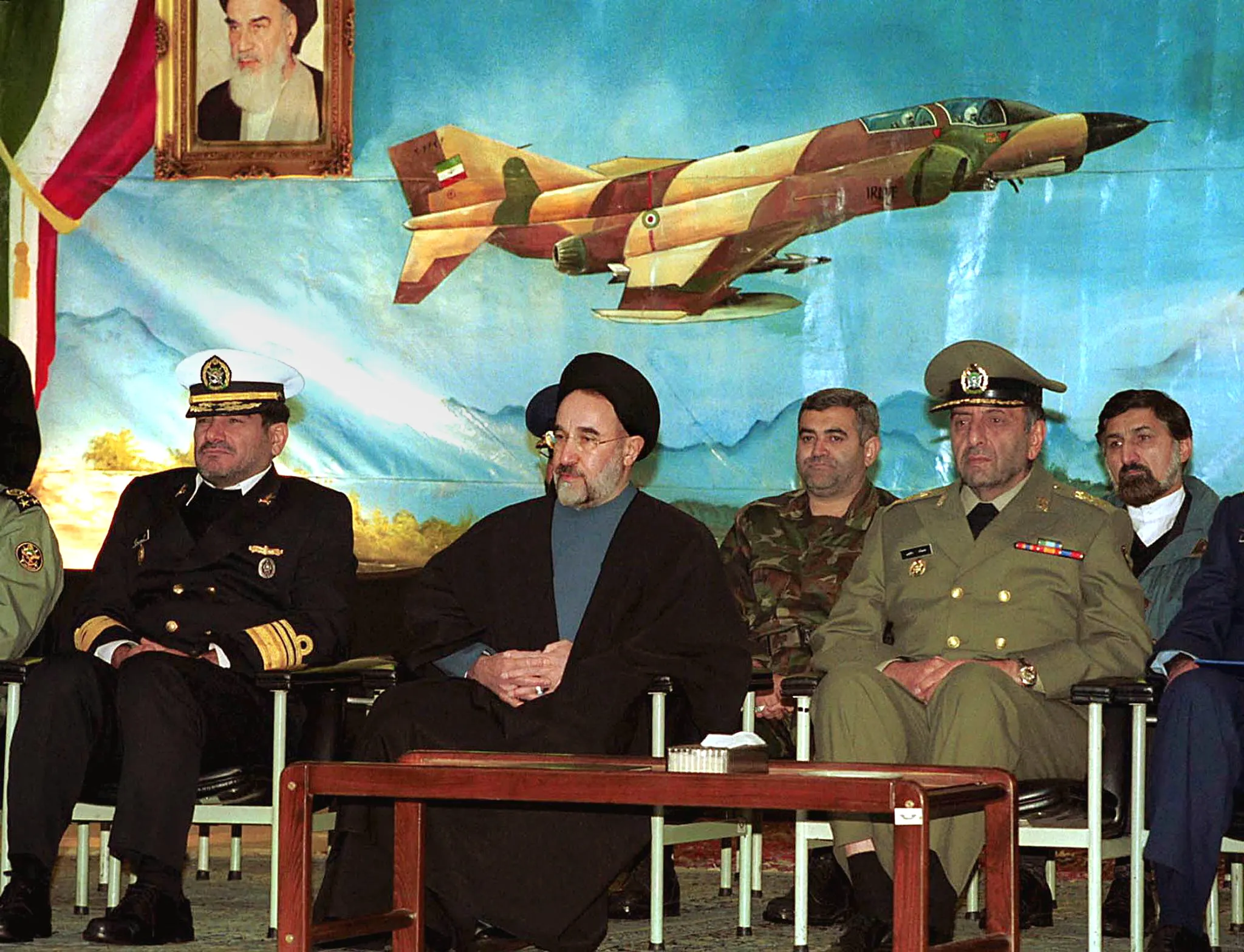
In a series of private meetings in Dubai, Qorvis executives offered Shamkhani guidance on how to shield his financial network from American regulators and navigate media scrutiny, according to the former employees. They asked not to be named to share details about the company.
Asked whether Qorvis employees had ever offered such guidance to Shamkhani, Sault wrote in an email that Bloomberg’s questions “attempt to create an alternative reality to fulfill your predetermined narrative rather than report an actual story.”
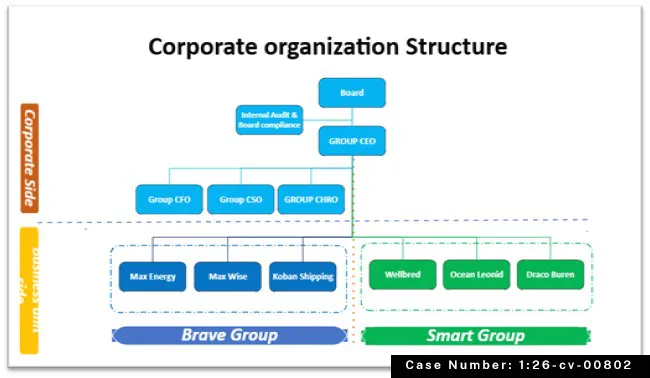
Well before 2024, Qorvis had begun working with Wellbred. At least some of the firm’s advice focused on how its CEO Ghazi Abualsaud should frame his relationship with Shamkhani to media and regulators, according to the three former Qorvis employees.
Sault didn’t respond directly when asked about that description of discussions with Wellbred’s leader. But she said that Abualsaud, whom she called “a friend and former colleague of several individuals” in Qorvis, disputes that he’s a Shamkhani associate. In a posting on Qorvis’s website last month, she said Abualsaud had “engaged us in 2022 to support the growth” of Wellbred.
In a civil forfeiture complaint filed in March, the Justice Department said Shamkhani and his associates acquired control of Wellbred around 2019 “to maintain a ‘brand’ that was not publicly perceived to be affiliated with Shamkhani or Iran.” The US Treasury Department sanctionedWellbred on Aug. 24.
Abualsaud didn’t respond to requests for comment.
Read more: How an Iran Oil Tycoon Got Inside the Western Financial System
Before the Justice Department took action in March, Wellbred’s corporate logo appeared on Qorvis’s website as a client, alongside several dozen others. Within days of the DOJ’s filing, Wellbred no longer appeared on Qorvis’s public-facing client list. Sault said her firm removed Wellbred “as we do not represent them on their litigation efforts (though we would be happy to).” After the US sanctions decision last month, Qorvis posted on its website that it “wound down” its relationship with Wellbred in March following the DOJ’s action.
In July 2025, President Donald Trump’s administration targeted Shamkhani and many companies that investigators said were part of his network. The US Treasury called it the most sweeping Iran sanctions package in seven years. Since then, Shamkhani has faced asset freezes, blocked bank accounts and travel restrictions. Nonetheless, five people with direct knowledge of the matter say Qorvis has continued to receive payments from business entities that authorities say are controlled by Shamkhani.
Sault didn’t respond to a question about whether Qorvis had received such payments. She said in an email that Wellbred had “paid past-due bills” to Qorvis, but she didn’t respond to a follow-up question about when the payments were made.
Federal statutes require lobbyists to seek a license to work with any sanctioned individual or firm or to collect payments from such entities, said David Tannenbaum, who worked in Treasury’s Office of Foreign Assets Control from 2011 to 2012 and now directs a consulting firm focused on sanctions compliance.
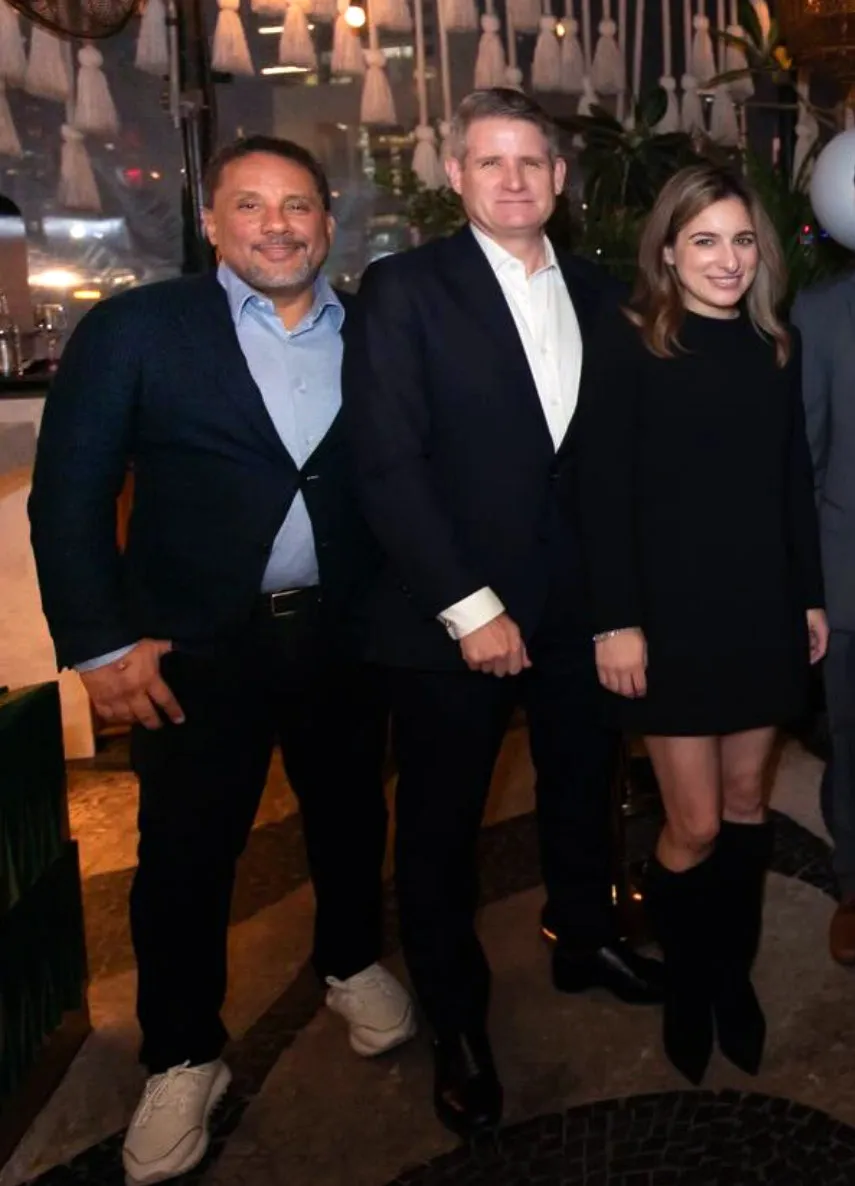
Roughly five months after the US sanctioned Shamkhani, Wellbred’s Abualsaud was photographed with Qorvis executives at a celebration to mark their firm’s 25th anniversary on the roof of Amazonico, a trendy Latin-themed restaurant in Dubai’s financial center.
Sanctions Windfall
By late March of this year, Washington’s relaxation of some sanctions meant that Iranian oil was fetching a premium to the world’s leading market benchmark for oil prices for the first time in nearly four years. That sudden change — Iranian oil had been priced at a $10-a-barrel discount earlier in 2026 — led to a multibillion-dollar bonanza for the politically connected trading entities that dominate the Islamic Republic’s oil trade. Among the top beneficiaries: Networks overseen by Shamkhani and Supreme Leader Mojtaba Khamenei, Bloomberg reported in April.
“It’s disappointing that the administration has given Russia and Iran windfalls without getting anything in return,” said Jim O’Brien, who served in various roles at the US State Department over three decades, including as sanctions coordinator from 2022 to 2023.
The decision also created a windfall for another major player in the dark fleet: Etibar Eyyub, whom Western authorities have linked to another corporate client of Qorvis.
After Vladimir Putin’s full-scale invasion of Ukraine in 2022, a Dubai-based trading firm called Coral Energy had emerged as a dominant player in the Russian crude trade, a major source of support for the Kremlin’s war machine. In time, officials in the UK and EU responded with sanctions — including against the man they said controlled Coral: Eyyub.
As US officials also put Coral Energy under scrutiny, Qorvis helped the company rebrand to 2Rivers Group in August 2024. A year later, after British and EU sanctions had hit, a Qorvis employee sent a press release on behalf of Coral/2Rivers that rejected assertions of sanctions violations and said: “Coral/2Rivers has initiated the formal process of dissolving the company.”
Read more: UK Issues Red Alert on Russian Shadow Fleet Sanctions Dodging
Beyond that public work, former employees say Qorvis engaged extensively with Eyyub. In meetings spanning Dubai, London and Washington, Qorvis executives advised him on how to leverage his insights about a rival trader to Western officials in an effort to avoid sanctions himself, according to five people familiar with the matter.
Sault, in a written response to questions, said: “Qorvis has never advised or communicated with Eyyub.”
Undisclosed Lobbying
Current and former US officials said that in their view the working relationships that ex-Qorvis employees described should have been disclosed under a US law designed to bring transparency to foreign governments’ attempts to influence American officials.
The Trump administration has signaled that it plans to limit enforcement of that law, which is known as the Foreign Agents Registration Act — though the Justice Department said in August that it’s considering several proposals to modernize the 88-year-old statute. In particular, the DOJ is considering narrowing an exemption in the law for bona fide commercial activities — the sort of distinction that modern economic statecraft, including sanctions, can blur.
A bipartisan group of US senators has also proposed new legislation that would require agents working on behalf of a Russian, Iranian, Chinese, North Korean or Cuban government or commercial entity to register, yet the bill’s prospects are uncertain.
Regardless, Sault said Qorvis had no obligation to register as an agent for Shamkhani nor Eyyub, saying neither has been its client. Qorvis has no problem registering under FARA when required, she said, and federal records show Qorvis has registered on behalf of dozens of foreign entities.
For now, lobbying experts said the Trump administration’s light-touch approach to FARA has emboldened several firms to go after riskier clients and to limit their disclosures.
“Right now, many in the industry know the administration is turning a blind eye, so they’re not filing for all clients,” said Dania Koleilat Khatib, a non-resident fellow at the Arab Institute, who researches US-Middle East relations with a focus on lobbying.
Amid its work for companies facing regulatory scrutiny, Qorvis has regularly met with US Treasury and State Department officials in an effort to influence policy, people with direct knowledge of the matter said. The firm has also sought to showcase its proximity to Trump world insiders on Washington’s social circuit.
A party the firm threw on the evening of the White House Correspondents’ Dinner last year drew Secretary of State Marco Rubio, former White House press secretary Sean Spicer and Trump ally Kari Lake — all depicted in photos posted to Qorvis’s Instagram account. Also in attendance were clients including Denis Solovyov, deputy chairman of the sanctioned Russian energy firm Novatek PJSC. In other Instagram posts, Qorvis has highlighted its interactions with other members of Trump’s cabinet.
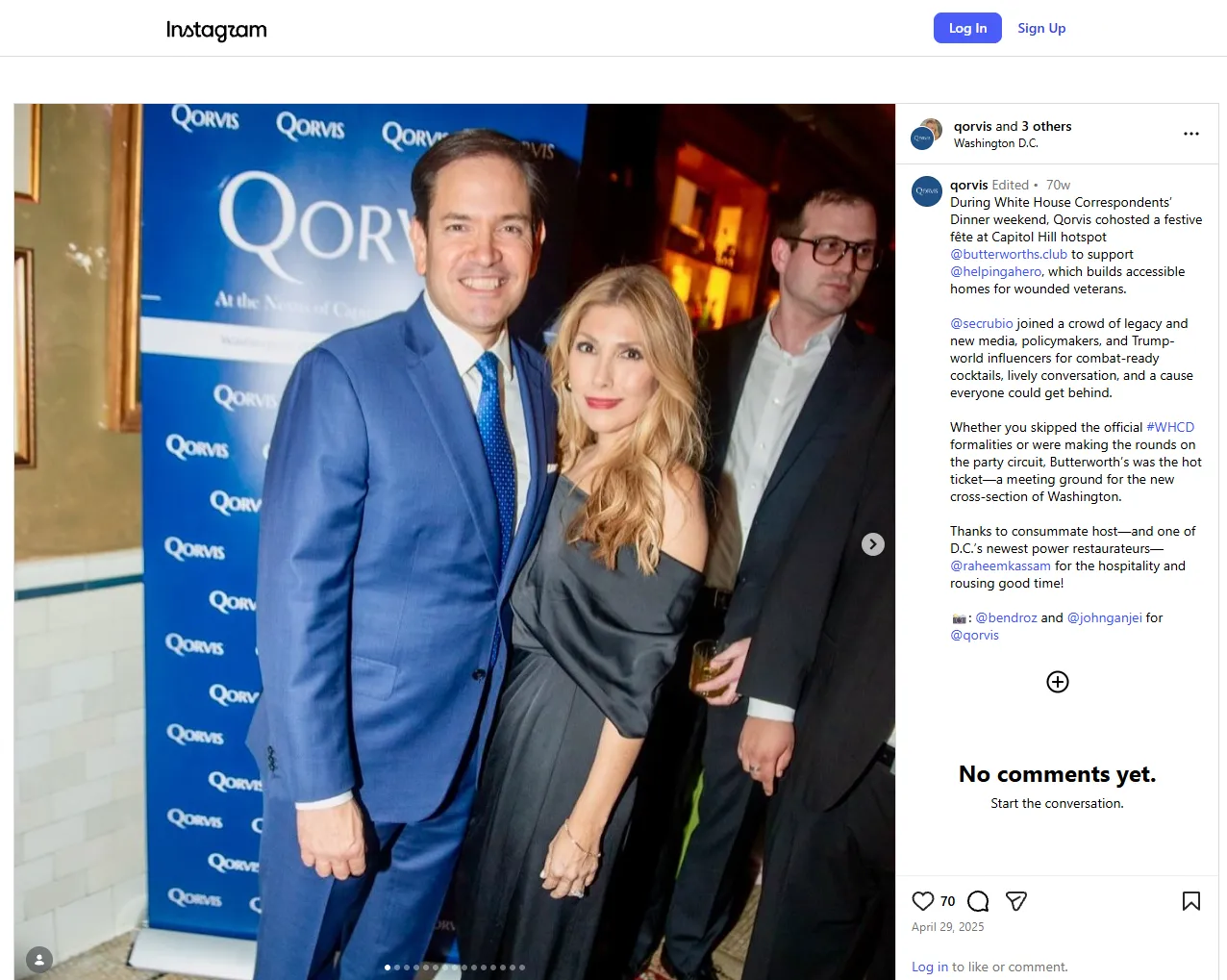
Nurturing a relationship with Rubio, which dates to his years in the US Senate, has been a recent priority for Qorvis given his influence on US sanctions policy, according to people with direct knowledge of the matter. Sault said the firm has not engaged on sanctions with Rubio.
In response to questions about the party, a person close to Rubio said that he attended an event that happened to be on the same night and at the same location as the Qorvis WHCD function. Since Rubio has been Secretary of State, he hasn’t had any meetings with anyone from Qorvis and doesn’t recall any meetings while he was a senator, the person said, adding that “if Qorvis has been trying to cultivate a relationship, they are failing badly.”
In March, a Qorvis managing partner, Brad Klapper, became the head of communications for the Board of Peace, a body that Trump launched in January with the stated purpose of settling global conflicts.
The board is mostly filled with heads of state as well as friends of Trump and his son-in-law. Trump is its inaugural chairman, a position that has no term limit. It’s unclear whether Klapper is being compensated as the board’s communications chief. Sault called his role a personal part-time endeavor. Klapper didn’t respond to a request for comment.
The firm has also made inroads into influential policy circles in the UK. Tom Sharpe, another Qorvis employee who’s a Royal Navy veteran and former spokesman for the UK Ministry of Defense, received a rare invitation to join a maritime sanctions task force led by Britain’s oldest security think tank, the Royal United Services Institute, in 2024. The task force regularly engages with officials involved in law enforcement and economic statecraft.
A RUSI spokesperson said Qorvis has stated that it never worked on behalf of Shamkhani or Eyyub. Sharpe declined to comment.
Lawmaker Scrutiny
In late August, the US revealed its so-called “Economic D-Day” package against Iran, with Treasury Secretary Scott Bessent threatening secondary sanctions against countries, banks and firms supporting the country’s economy.
The tougher approach contrasts with the March decision to relax sanctions — a move that caught heat from lawmakers from both parties. Congressional criticism subsided in April after Bessent said the administration wouldn’t renew its waivers for Iranian and Russian crude. But in the following months, US officials repeatedly changed tack, at times adopting a more lenient approach.
During a June hearing, Senator Cory Booker, a New Jersey Democrat, pressed Rubio on why Trump officials allowed Tehran to benefit from Washington’s war effort, citing billions of dollars that the Islamic Republic received after the March decision to dial back restrictions.
“That was very shocking to see the dark fleet, which had been on the ropes, get this massive shot in the arm,” said Tannenbaum, the former OFAC official.
— With assistance from Anthony Di Paola
Ben Bartenstein is a senior reporter for Bloomberg News in London. His investigations on Iran, Russia and Venezuela have prompted changes in government policy and received industry honors.

